

“O my comforter in my sorrow, my heart is faint within me” Jeremiah 8:18
God Is Our Comforter
He has given us His Holy Spirit to carry us across the desert sands of all our trials.
“O my comforter in my sorrow, my heart is faint within me” Jeremiah 8:18
God Is Our Comforter
He has given us His Holy Spirit to carry us across the desert sands of all our trials.
This scripture reminds me of faith and the works that follow. Vision is defined as “the ability to perceive something not actually visible.” Being incarcerated with no programs on reform or education, how can one perceive hope of a better life? This is a question that is in the forefront of my mind daily.
by LA
 Luke 16:1-13
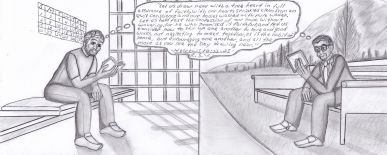
When I read Luke 16:1-13, I am forced to think about the state of American politics today, where we find certain political families who have never once planted a crop, offered a legitimate service, traded a single good at market nor invented or assembled one widget. Yet somehow they were able to amass a fortune worth hundreds of millions of dollars. An impossibility for a career in public service, making it more than obvious that they are selling the favors of their positions much like the steward in this reading. These sorts are always in the press, going form one scandal to the next, lying their way to higher and higher offices, with no end in sight.
————————————————————–
INSIGHTS, 17 YEARS IN PRISON
————————————————————–
A month ago I met with two wonderful clergy, and our conversation meandered into fruitful territory. An important conversation, it was also the kind you can’t prepare for. So when our wandering words brought us to an important precipice, and I was invited to jump off, I quailed. Seventeen years of incarceration and over thinking about my crimes has led me to an untold number of insights and revelations so imagine my regret when, after being invited to share some, I failed at the task.

Jeremiah 18:1-11
“Broken, but not Shattered”
by AMN
One of the most overlooked descriptions of our thrice holy God is that of a potter working with freshly-made clay. In the beginning of Jeremiah 19, the prophet is sent to a potter’s house to watch the craftsman work with the raw material. As Jeremiah watches the potter, he notices that it takes a second effort before the potter is satisfied with the vessel’s form. Continue reading
 Apostolic Letters from Prison
In the book Ministry with Prisoners & Families: The Way Forward, Madeline McClenny-Sadler offers a “Letter to African American Churches Concerning the Saints Coming Home from Prison.” It uses “the hybrid style of a Pauline epistle and a scholarly article” as a call to action (140).
Inspired by her letter, several PrisonLectionary.net contributors took up the same task. The second comes to us from “AMN .”
In case you missed the first, you can find it here.
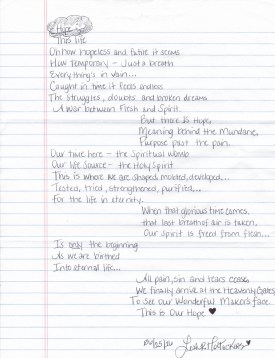
“Hope: This life”
Oh how hopeless and futile it seems
How temporary – Just a breath
Everything’s in vain…

This sermon, by Matthew Harper, was read during a worship service at St. David’s Episcopal Church in Chesterfield, Virginia, on Sunday, August 14, 2016.
Isaiah 61:1-3
Psalm 103:1-13
Matthew 25:31-45
Prison is a terrible place. The purpose of prison is for it to be a terrible place. Where there are problems in our world our justice system seeks out the offenders and send us here. We are sent here to protect society, to punish us, and perhaps to give us space to repent and grow.
Prison is full of people. Each prisoner is a person full of good and bad, carrying wounds and inflicting them. We too have our hopes and dreams, as well as sorrows and regrets. Some of us are redeemed, some not, and all struggle with addictions, pride, loneliness, and sorrow. We are beautiful and amazing, and also completely messed up. We are all too human.
Continue reading the full sermon on St. David’s website here.
by LA
Psalm 71 is one of my very favorite psalms. In fact, there was a time in my life when I recited this psalm three times each night before bed, from memory. To me, this psalm speaks to the plight of not only the prisoner, but anyone who finds themselves ensnared in our criminal justice system. The first five verses alone sum up the majority of my most common prayers as a prisoner.
What person who has ever been at the business end of criminal prosecution cannot relate to verses 9 through 11? I know that whenever I read these verses I cannot help but to visualize the three prosecutors assigned to my case, sitting around a long conference room table like the Bond villains of SPECTRE, saying things to each other like, “This God-forsaken dirtbag! Let’s do whatever we have to do to put him away for as long as we can. Who can stop us?”
Every person serving an extended sentence thinks about and worries about how old he will be when or even if he is ever released. For instance, if I am forced to serve all of my current sentence, I will be over 65 when I am paroled What sort of life will I have left? How will an old used up ex-con ever find gainful employment? Even if I am somehow able to keep myself up to date on the current technologies and the swiftly changing demands of contemporary employers, what sort of physical condition will I be in after so long a period of forced inactivity, eating sub-nutritious foods, under sub par healthcare? Most at that age would be unable to get out of bed and get around to go to work.
What of my other needs? What sort of family support can I expect to still have? Will anyone even still be living? These thoughts are constant stressors that plague the minds of those subjected to long-term incarceration. Countless times I have prayed that the Almighty will not forsake me in my old age when I am grey-headed. Every incarcerated believer knows that our Heavenly Father is our only means of support we can be sure of. Thankfully, He is also the only means of support anyone ever needs.
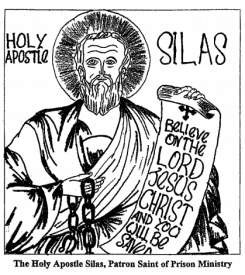 Apostolic Letters from Prison
In the book Ministry with Prisoners & Families: The Way Forward, Madeline McClenny-Sadler writes
“What would the apostle Paul do if he heard about the mistreatment of brothers and sisters who return to our congregations and communities after being released from prison? I think we know exactly what Paul would do. Paul would write a letter!” (140)
Thus, McClenny-Sadler offers a “Letter to African American Churches Concerning the Saints Coming Home from Prison.” It uses “the hybrid style of a Pauline epistle and a scholarly article” as a call to action (ibid.)
Inspired by her letter, several PrisonLectionary.net contributors take up the same task. The first comes to us from “EB .”
 Prison Lectionary