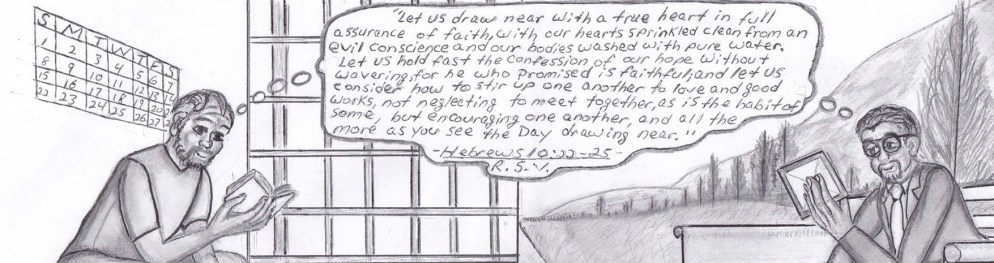
Saturday, First Week in Advent

by Matthew B. Harper

And Jesus said to them…, “Render therefore to Caesar the things that are Caesar’s, and to God the things that are God’s” (Matthew 22:20-21)

When Mary accepted God’s call to her, I don’t think that she had any idea what was coming. She risked so much, and lost so much, all for God. Being pregnant and unmarried she risked being rejected by Joseph and her family, she risked being stoned for adultery, she risked being condemned. When Mary traveled to Bethlehem she left her friends and family behind. There would be no midwife to deliver her baby, no family to welcome it, and no village to celebrate, rejoice, and bring gifts.

In all that Mary lost, she willingly gave it up for God. And God, in turn, blessed her so overwhelmingly. With no midwife to announce the birth, God sent the choirs of heavenly angels. With no family to gather, God sent the shepherds. With no village gifts for the child, God sent the wise men bearing gifts for a king. Mary offered up to God what little she had, and God gave it back to her with divine abundance.

We get so caught up in stuff this time of year. We get so focused on things. And I love stuff, I love things. But these things are so incidental to our faith. In my life I have lost so much. And not just lost, I have thrown away, wasted, squandered and destroyed so much. And I think that to some degree we all have. We offer to God what little we have left. And God blesses us, God restores with divine abundance in ways we could never have foreseen.

God restored to Mary, and through Mary’s offering God blessed all of humanity beyond compare. Our God is a loving God of restoration. God restores, and God continues to restore to us.

Born thy people to deliver, born a child, and yet a king, born to reign in us forever, now thy gracious kingdom bring. (Hymn 66)

Friday, First Week in Advent

by Matthew B. Harper

Then he said to his servants, ‘the wedding is ready, but those invited were not worthy. Go therefore to the thoroughfares, and invite to the marriage feast as many as you find. (Matthew 22:8-9)

The shocking thing about this parable of Christ’s is that we are the latecomers to the banquet. The ones who were out and about in the alleyways and poorhouses that night; those that were brought to the wedding feast and clothed with the festal garments, they are us.

It is humbling to think of ourselves in this context. But it is in this capacity that Christ comes to us, and that God offers us so much. I would rather think that God somehow needs me, but God doesn’t. It is that God wants me! I might think that I can do God’s work, but I can’t. It is the amazing and nearly unspeakable miracle that God wants to do some of God’s work through me!

And just this month as children sit and hope for the gifts of Santa, we must be ready to accept the gifts of God. We must be willing to come before Christ humbled and ready to receive the commissioning that God has for us. If we have talents and skills, then they were only given to us for a purpose. Jesus talks in this parable of giving the guests the wedding garments to wear. What garment has Christ given you? Do you have the humility to accept it? Do you have the courage to wear it?

The poor and destitute are always more ready to receive God’s love. We already know that we cannot make it on our own. All too often we think we can do it ourselves, and we are so wrong. So today I dare you to climb onto the lap of you divine father, and when you are done telling him what you want for Christmas, I dare you to receive and accept what God brings you.

He comes, the prisoners to release – He comes, the broken hearted to bind, the bleeding soul to cure; – let every heart prepare a throne, and every voice a song. (Hymn 71)

Thursday, First Week in Advent

by Matthew B. Harper

Therefore, beloved, since you wait for these, be zealous to be found by him… and count the forbearance of our Lord as salvation (2 Peter 3:14-15)

It is inevitable that we, human that we are, will work to seek God. We will try to learn, and to do, to bridge the immense gap between God and us. And yet, as Peter so strongly reminds us, it is Christ who comes to find us.

I have been angry at God. In the pain and anger of my life I have rebuked God, and blamed God. I have heaped the unfairness of the world on God, and I have laid both the wrongdoings that I have done and that have been done to me on God. And I have turned my back on Christ and looked elsewhere for answers.

If you were to give a thirsty man advice on digging a well, the advice would be simple: find the right spot, dig a deep hole. You would not stand by and let him dig 20 different wells only 10 feet deep; but that is what I did, and many of us do, with other religions and philosophies. When you need a well you dig one 200-foot hole. I may have picked up some Buddhist tendencies, but it was only when I came home to Christ, and was willing to dig deep, that I found solace and comfort. God found me, called me home, and welcomed me.

When we are angry at God, when our faith wavers, the answer is never to go on some superficial journey to other ideas. Instead it takes a step of deliberate faith to dig deeper. When we don’t have an answer, we know God does. Dig deeper. Like the wise men that we remember on Epiphany, be willing to journey and to go to a new place to search and find Christ, and to be found by Christ.

Thank God that our straying and questioning are accepted and forgiven. The forbearance of God is great. Be zealous to be found.

With God the Father you are one, and one with us in human flesh. Oh fill our weak and dying frame with godly strength which never fails. (Hymn 55)

Wednesday, First Week in Advent

by Matthew B. Harper

Jesus said to them, “Truly I say to you, the tax-collectors and the harlots go to the kingdom of God before you.” (Matthew 21:31)

It is disturbing to think that the people we least approve might be the first ones into heaven. And not just might be, according to Jesus, they are. If you think you are humble, think of the prisoners getting into heaven ahead of you. Does it disturb you?

The question is no easier from behind bars. In here there are inmates who are hated and despised. The rapists are a second class citizen in prison, the snitches rank a little lower, and it simply doesn’t get lower than the child molesters. And yet when I find it difficult in my heart to reach out to them in kindness, I hear these words of Christ in my head. When I harbor judgment and resentment, it is indeed they who will go before me into heaven.

The repentant criminals are among my favorite people in the world. The person who has honestly looked into the depths of their own heart, and seen the guilt and the need; and who has then in their longing and grief turned to God and let Christ fill and sanctify them; I love these men. But I find that I love those who aren’t repentant as well. When I see them in their pride and anger, self-righteous before man and God; I find only love, pity, and sorrow in my heart.

Is our church a Sunday country club or a hospital for sinners? I welcome and rejoice with my favorite people in church. We are all repentant sinners. But I also welcome those that I struggle with. I welcome the snitches, the child molesters, the rapists. I struggle, for I too need the maturing ministry of Christ, but I welcome them.

Christ turned none away, not even me, can I do less?

Herald, sound the note of pardon – those repenting are forgiven; God receives his wayward children, and to them new life is given. (Hymn 70)

Tuesday, First Week in Advent

by Matthew B. Harper

Therefore I intend always to remind you of these things, though you know them and are established in the truth you have. (2 Peter 1:12)

It isn’t often that we stop and think about the deep foundational issues and truths that define our lives. When we do take the time to think about or talk about these issues, we always want to cling to very high and noble ideas. But the truths that are actually established in our lives are the ones that are made manifest every day. It can be disappointing if we see that what we claim and profess to believe, we do not live.

In prison it is a common mantra to hear men say that they will begin to live a more upright life in their last year in prison; or that they will go to church ‘when they get out.’ I always tell them that the truth is that if you aren’t doing it, then you aren’t going to do it. What these men don’t grasp is that if they cannot live a righteous life now, then they will not be able to live one when they get out. Tomorrow starts now, and as you prepare so shall you live.

Prison is a time of preparation, so what are you preparing for? Advent is the time of preparation, what are you preparing for? If you live in and focus on the pain and depressions of prison, then that is what you will be established in. If you live only for the toys and presents of Christmas, then that is what you will be established in. But if you live in the joy that the Lord brings, if you actually live it, then it will be established in you. The deepest roots of our faith are sown when we can find the strength and joy of the Lord in hardship and pain. God is there. Tomorrow starts now. God is here.

As you prepare, so shall you live.

Come thou long expected Jesus, born to set thy people free:

from our fears and sins release us, let us find our rest in thee. (Hymn 66)

Monday, First Week in Advent

by Matthew B. Harper

Most of the crowd spread their garments on the road… and the crowd that went before him…shouted, “Hosanna to the Son of David! Blessed is he who comes in the name of the Lord!” (Matthew 21:8-9)

The people of Jerusalem were so happy to welcome Jesus. They cheered him and lay their garments in the road. Oh, how the Apostles must have rejoiced on this day. This was the Messiah, the one that they had forsaken all others to follow, and they must have rejoiced to see the crowds hail Jesus. What a ‘mountain-top’ experience. And yet it was this very same crowd that would chant for his death only days later. What a deep ‘valley.’

I am the rector of the Kairos community here. A Kairos retreat is a high mountain top experience for so many men, and I am always blessed just to be here when God is blessing them. But a Kairos retreat is only three days, and the fourth day can be hard. The mountain top experience must be kept alive, even when we are no longer on the mountain. No matter how powerful the talks are that are given by the ‘outside’ (free) team members, the last talk of the retreat is always given by a prisoner. It is a talk about how we go forth back into the prison, often a deep and barren valley, and still let this experience be alive within us. And yet the answer seems simple: if the mountain is God, then when we go into the valley we must bring the mountain with us!

The spiritual disciplines of prayer, mediation, study, sleep, and godly toil are well proven by spiritual people throughout history. They are proven, because they work. They are ways that we structure our lives to make constant room for God. They are ways that when we find ourselves in a valley, in a desert, we are welcoming God in. And when we welcome God, God is present.

Sleepers, wake!” A voice astounds us, the shout of rampart guards surrounds us: “Awake, Jerusalem, arise!” (Hymn 61)

First Sunday in Advent

by Matthew B. Harper

So then let us not sleep, as others do but let us keep awake and be sober.

(1 Thessalonians 5:1-11)

Today we light the first candle of our Advent wreaths. A candle that welcomes light into our world, and a light in the window to wait for our coming Savior.

‘Let us keep awake and be sober’ cries Paul to the Thessalonians. What a difficult command this is to us. In our culture, in prison and out, we do not want to wait or be sober. Instant gratification and indulgence are the mantras of the culture. But seeking the desert, as Jesus did after his baptism, was about being quiet, and waiting on God. When we create stillness, then there is room in our lives for God to fill.

As a child I loved to devour the toy catalogs. As Christmas approached I would make longer and longer lists of the things that I ‘just had to have.’ In prison I am prone to do the same. I read my magazines and books full of boats, and scuba diving, and in my mind I make my lists. But I have to wait, and wait. In prison I have had to learn patience, it has been forced upon me. It has not been easy, but it has been a gift. I am learning how to be quiet and present to reality, and neither to live in my past or my future.

We stay busy. This time of year we seldom slow down even for a moment. In prison I work hard to stay occupied with productive things. But the hardest spiritual work there is often comes when we do less, and do it better. When we find times to deliberately slow down, and quiet down, to spend time with God.

I have my dreams, and sometimes they console me while the pain and longing grips me; but when the pain is the most intense, and the yearning reaches to the depths of my heart; in those times I cannot dream, I can only grow quiet and sit safe in the hand of God.

Hark! A thrilling voice is sounding. “Christ is nigh,” it seems to say; “Cast away the works of darkness, O ye children of the day.” (Hymn 59)

Advent Devotional Introduction (part 5)

On Sunday, November 29th and every day until Christmas, a daily reflection will appear to accompany and inspire readers in their own time of preparation.

Highways in the Desert

by Matthew B. Harper

Introduction

Part 5

click here to start with Part 1 (in case you missed it)

This is a time to gather in love with our communities. This is a time to spend with those whom we love, and love us. This is a time to reach out to those who need our help. This is a time to show love in whatever actions, ways, or gifts we can. And all of this is in celebration and love for God, and the love of God.

During this time of year we light candles. We do it to mark and remember how Christ came as a light into a dark and lost world. Prison is a darkness difficult to understand or imagine, and the light of Christ shines brightly. This is a barren desert, and Christ is here. Whatever the desert in your life, whatever the joy, let us build a highway for our God.

What follows are 42 devotionals: one for each day of Advent, for Christmas Eve, for the 12 days of Christmas, and for the Epiphany feast. All scripture references are taken from the New Revised Standard Version of the bible, but any good translation will suffice. I encourage you to read the Daily office readings, read the devotional, and then spend a few quiet moments in prayer meditating on what God is speaking to you on this day. The scripture verse for each day can serve as a powerful focus for meditation, and so can the names of God used during the twelve days of Christmas. At the end of each devotion are some words of prayer and praise from the seasonal hymns of the Episcopal Hymnal of 1982.

Subscribe now to the Prison Lectionary blog, like us on Facebook, or follow us on Twitter. Don’t miss the five-part introduction to our devotional series, the devotions, or any other posts.

Advent Devotional Introduction (part 4)

On Sunday, November 29th and every day until Christmas, a daily reflection will appear to accompany and inspire readers in their own time of preparation.

Highways in the Desert

by Matthew B. Harper

Introduction

Part 4

click here to start with Part 1 (in case you missed it)

Advent and Christmas fall in the winter months in most parts of the world. But the cold barrenness of winter is not just mitigated by the memory of fall, or the hope of spring. We use the evergreen trees, the mistletoe, and the poinsettia to mark the season because amidst the cold snow they are a vibrant explosion of life. They are a reminder that in the cycles of the year, even the cold and hard ones, God is active with new and wonderful life.

So I write to share the same with you. I write to speak as one in the desert, of how God is real and present in this barren place. Parables and stories have power, and I want to offer you some of mine so that you might find witness to God. We all have times in the desert; whether we choose to seek its solitude, or are thrust out into it through circumstance. God is with us in the desert.

But being in the desert begs of us to take action. God will not simply barge into our lives, we must invite God in. ‘Prepare ye a highway’ cries the prophets, and so we must. In our times of barrenness we must prepare an entryway for the Lord. This highway is not only the way of the Lord to us; it will also be our way back into loving community. In the midst of chaotic Christmas I challenge you to do this. To find a daily discipline of prayer and study that leads you to God in a new and wonderful way. To let Christ be born again in your heart in a wonderful joy.

In a fast paced and instantly gratified culture Advent has quickly become a forgotten season. Instead of a time marked by spiritual preparation for Christ, and a time remembering the long wait both for his birth and his return, we have traded our Advent for a time of store sales and wrapping paper. Advent and Christmas are not really about gifts, they aren’t really about lights in the trees. Advent is a time to remember the amazing gifts of God. When our relationship with God was broken, when there was nothing that we could ever hope to do to heal it, it was then that God came to us. God came not in the terrifying majesty and anger that God has a right to, but God came as an infant and humble baby boy, full of love, to offer his very life as a sacrifice for us. Christ has come, and healed this rift with God. This is God’s constant and present gift to all of humanity.

Subscribe now to the Prison Lectionary blog, like us on Facebook, or follow us on Twitter. Don’t miss the five-part introduction to our devotional series, the devotions, or any other posts.

Advent Devotional Introduction (part 3)

On Sunday, November 29th and every day until Christmas, a daily reflection will appear to accompany and inspire readers in their own time of preparation.

Highways in the Desert

by Matthew B. Harper

Introduction

Part 3

click here to start with Part 1 (in case you missed it)

Prison is full of pain and strife, but that does not alienate God. Prison is full of despair, and that is where God is needed the most. In the world, God is often put aside by false idolatry. People get too busy, and push God aside. But there is no such thing as too much pain, longing, or despair for God. It is often in our pain that God is the most real and present to us. We live in the desert, and God lives here with us.

There have been so very many people in the history of our faith who have sought out the desert for a time. They have left family, friends, and security to travel into the wilderness so that they might seek God. Sometimes they have even formed communities in these places where they could seek and worship God together. I live in just such a place. I may not have made a deliberate and conscious decision to be here, and I could never have imagined the diversity of my fellow brothers, but we live and seek God together.

During our times in the desert it is not just the past memories or future dreams that sustain us. We do not simply think of how God has blessed somebody ‘back then,’ nor do we simply sit around and wait for a second coming. We are sustained in the desert by the very real and constant presence of our Lord and King. It isn’t just that Christ the King saved us; it is also that Christ is a constant presence in our lives and community. We are richly blessed.

Subscribe now to the Prison Lectionary blog, like us on Facebook, or follow us on Twitter. Don’t miss the five-part introduction to our devotional series, the devotions, or any other posts.