Lectionary: Fourth Sunday in Lent

by LA

2 Corinthians 5:16-21

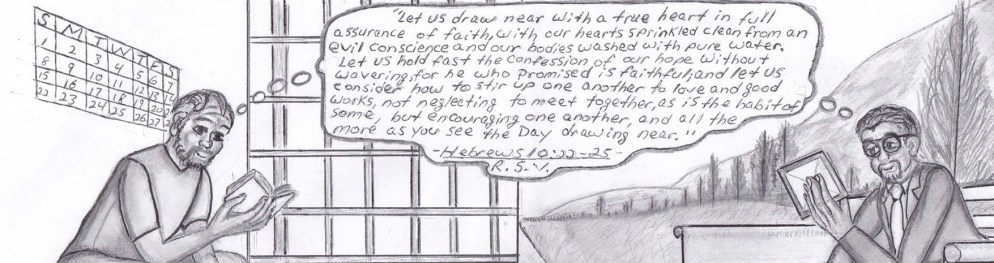
In 2 Corinthians 5:16-21, Paul is writing to early Christians of a first-century Greek church but he might as well be writing to contemporary believers on my own prison gallery today. It is of the utmost importance that we understand that once we know Christ spiritually and claim him as our Lord our lives are no longer our own, but his. Bought with a price. Too many of my fellow inmates who claim to be followers of Christ never really follow him anyway or in anything consistently.

In verse 20, Paul states that we are “Ambassadors of Christ.” We need to act as such. Our old self is dead. Lent 4C 2CorWe are New Creatures in the Lord. It does us no good to be claiming Christ and still be doing the same old things and acting the same old ways as before we accepted him. This is an important concept for all believers the world over, but it is even more vital in a prison environment where everyone watches everyone else, at all times.

Anyone can talk the talk but people in here want to see if you walk the walk. Our Christian walk is one of the most powerful tools at our disposal. I personally must always be mindful that the eyes of those who would do the will of our infernal adversary are always on me. Watching and waiting with baited breath for my stumble and their chance to advertise it as an argument against the veracity of the Gospels.

In a place of abounding darkness such as this the Christian prisoner must be the light in dark places. Only by our good example will others be drawn to ask us about our Lord. As believers in Christ, the whole world holds us up to a much higher standard and rightly so, for if gold rusts what should iron do?


Lectionary: Third Sunday in Lent

by LA

Psalm 63:1-8

Psalm 63 is almost an identical recitation of my nightly prayers. David was in the wilderness of Judah when he composed this psalm and as anyone who has ever served a minute of time could tell you, prison is very much a spiritual wilderness. David speakers of searching for God and seeking him out as a priority in the first verse. Lent 3C Ps63 I myself must seek God that way. In my environment a person can very easily be pulled further and further toward debauchery and away from God by the unending siren’s call of immoral distraction. Without earnestly searching for God, minding and renewing ourselves of that effort each and every day, a person will become lost and worse yet may lead others astray as well.

The image David invokes when he describes his thirst for the water of God in a dry and thirsty land, is one that is relatable to any Christian prisoner in any cell house in America. But, like David I too have seen the glory of God and I too praise him with all my body, mind and soul.

In verses 3-5, David understand that just by praising God he is nourished and his soul is satisfied. If I have nothing else I have the ability to praise and worship god. That thought always brings shalom to my bone and peace to my anxiety.

When I read verses 6-8, I am reminded of the countless times when I am kept up at night by the noise and chaos of the cell house. I am forced to pray myself to sleep and I am grateful for it. “For what?” you might ask. No matter how clamorous or vexing the assault on my sanctuary of serenity may be, the Lord’s peace is equal to the foe. It’s a form of spiritual warfare. Night after night, spirits of torment manipulate tortured souls to draft others into their ranks. I lie on my bunk and like David meditate on the Lord in the night watches. I pray for those poor unfortunate souls who are so agonized nightly and it forces me ever closer to God each night. And for that I am extremely grateful and I rejoice.


Third Sunday in Lent

By Matthew B. Harper

Exodus 20:13 – You shall not murder

All of us have broken a commandment or two. We have lied, or coveted, and surely we have treated our parents with disrespect at one time or another. Some will even confess to adultery. But we console ourselves by saying that these are only ‘minor’ commandments. Well I write to you today as a murderer serving time in prison. That’s a major commandment by anybody’s standard.

But the truth is that there are no distinctions in the commandments of God. The Exodus story calls the last commandment as important as the first. In the eyes of God we are sinners, and all of us need the mercy of God through Christ.

Paul makes a distinction between our lives of flesh and spirit. In the flesh I serve my time in prison, so be it. But no time in prison can repay even a tenth of the crime that I have committed. It is only by the mercy of God that in the spirit I am justified.

And yet no mercy of God can still in me the nature to sin. Even Paul bemoaned the fact that he did those things that he did not wish to. Our flesh is weak, and we all succumb to temptation more than we ought. By the grace of God we are given the strength to overcome much of this nature and to become children of God.

Be careful how we judge others, for all of us are found wanting. We live in the world, and there must be justice and punishments of the world, but we cannot let ourselves think that this is the justice of God. All are found wanting in the eyes of God, and by the mercy of God all who ask will be forgiven.

Almighty God, who seest that we have no power of ourselves to help ourselves: Keep us both outwardly in our bodies and inwardly in our souls, that we may be defended from all adversities which may happen to thy body, and from all evil thoughts which may assault and hurt the soul; through Jesus Christ our Lord, and the Holy Spirit. Amen” BCP167

Saturday, Second Week in Lent

By Matthew B. Harper

1 Corinthians 7:16 – Wife…you might save your husband. Husband, …you might save your wife.

Paul cautions us to remain tied to the people who would remain tied to us. Even if they are unbelievers, they may become saved through our lives and our ministry.

I am a young white male, a biker, a weight lifter, and wear too many tattoos. I am also a Christian, a teacher, and a worship leader. I often attract all sorts of people, and all sorts of friends. I turn none away, but minister to all who are in need, and all who will listen. I have often been criticized by some of my Christian brothers for spending time with men who were in biker gangs, or racist gangs, and it mystifies me. I have found many of these men to be good men, however misguided. Who will minister to them if not us?

Recently several men from the Christian Motorcycle Association came in to evangelize out on our recreation yard. These men from the CMA roared right onto the yard on beautiful bikes, and then in their leathers and tattoos they preached to men about our Lord. One older man, a semi-retired preacher, put 78,000 miles on his bike in the last two years just driving to different prisons across the country to evangelize! Paul cautioned the Corinthians to remain with God in whatever condition we were in when we were called.

So when you see bikers on the road, look to see if they wear a patch for an outlaw club, or for Christ. And even if they ride for a club, who will minister to them if not you? Minister to whomever God places before you; speak into whatever ears God has opened; turn none away. Christ’s table is open to all.

That it may please thee to send forth laborers into thy harvest, and to draw all mankind into thy kingdom, We beseech thee to hear us, good Lord” BCP 150

Friday, Second Week in Lent

By Matthew B. Harper

Psalm 69:6 – Do not let those who seek you be dishonored because of me…

Not all Christians are called to be evangelists. When asked to speak to others to share our faith we grow nervous and silent. But as Christians our greatest evangelism is simply in how we live our lives. Others watch us, and if they know us to be a Christian then they will draw certain conclusions about our faith based on how they see us live.

In prison we have a great gift in the close and constant proximity of our fellow believers. It is true that the overcrowding of Virginia’s prisons leads to heat, poor hygiene, fights and no privacy; but it also puts believers in a close community that is rivaled only by monasteries. When we struggle on our walk in some thoughts, word or deed (BCP-79) then there is another brother close by to hold us accountable. We all struggle with trying to live a righteous and upright life, and we struggle together as a Christian community.

But the potential to harm others is also great. If we claim to be faithful, and men see in us depravity, then they may never seek God. To lead someone away from God would be as great a tragedy as it is a joy to lead someone to God. Our whole community becomes a life of evangelism. Other prisoners see how we live, how we struggle, and how we continue to lift each other up to a better way of living. Often it is not we who must go and seek men to evangelize to, but men who come to us with questions. Willing or not, we are evangelists.

That it may please thee to bless and keep all thy people, We beseech thee to hear us, good Lord” BCP 150

Thursday, Second Week in Lent

By Matthew B. Harper

1 Corinthians 6:19 – Or do you not know that your body is a temple of the Holy Spirit within you, which you have from God, and that you are not your own?

Paul begins this passage by quoting the Corinthians, and then rebuking them kindly. Are all things good and legal for us as Christians? Yes. The sin comes from how we use them and if we corrupt them. Anything on this earth can become an addiction and destroy, and that is the danger.

I know many men in here whose lives have been destroyed by their addictions to drugs and alcohol. Yet Paul tells Timothy in a letter to him to enjoy a drink of wine from time to time. Is there a conflict in this? Not at all. For Paul reminds the Corinthians that all things are permissible, but not all good, and we should not be dominated by anything. Alcohol, (like drugs, sex, money, clothes, food…) is not in and of itself evil, but to be dominated by an addiction for it is. For it is to be in subjection not to God, but to something of the world. The evil comes not from any one substance, but from our usage of it. The responsibility is upon us, as believers, to allow the spirit to help us discern the proper usage for God’s gifts.

Christ has purchased freedom for us but that does not mean that we are to indulge in anything we please with wanton abandon. We are to test all things by the spirit of God. Above all we are not to allow ourselves to become in subjection to the addictions to anything other than God. All things are permissible, but not all things beneficial, and our only addiction should be to God.

That it may please thee to illumine all bishops, priests, and deacons, with true knowledge and understanding of thy Word; and that both by their preaching and living, they may set it forth, and show it accordingly, We beseech thee t hear us, good Lord” BCP 150

Wednesday, Second Week in Lent

By Matthew B. Harper

Mark 4:20 – And these are the ones sown on the good soil: they hear the word and accept it and bear fruit, thirty and sixty and a hundredfold

Viktor Frankel wrote, after spending time in the Nazi concentration camps: “Everything can be taken from you but your attitude. You always have the power to make the decision how to act.”

In today’s parable Christ divides the followers into four different types. Notable among those are those who wouldn’t hear. We know from Psalm 40:7 that it is the Lord who opens our ears. And still more there are those whom God opens their ears to receive the word, but they allow Satan and the ‘cares of the world’ to lure them away from the word. From Christ himself we learn that if we are to bear fruit for God then we must receive the word, we must study and pray so that we might become ‘rooted’ in the word, and we must not allow ourselves to be drawn away from the word by the cares of the world. Only then: receptive, rooted, and devoted, can be bear fruit for the Lord. For we remember the opening of the Gospel of John, “the word” is the Logos, who became incarnate as Jesus the Christ.

We have the power, no matter our circumstances, to decide how to act. In the face of hurt, fear, anger, and resentment we have the choice to act with godly grace, and to sew the word and the work of out Lord. Will we act today for the Lord, and against him?

We sinners do beseech thee to hear us, O Lord God; and that it may please thee to rule and govern they holy Church Universal in the right way, We beseech thee to hear us, good Lord.” BCP 150

Tuesday, Second Week in Lent

By Matthew B. Harper

Psalm 62:1-2 – For God alone my soul in silence waits; from him comes my salvation.

Paul talks of the purity of the church, and Jesus tells us about the unity of it. Our strength comes when we stand united in faith, brothers in the family of God.

When I first came to prison I was terrified. Being a ‘new fish’ in a major penitentiary is an uncomfortable experience. God has given me a gift in my size and strength, but this is prison, and those things do not always matter.

I have been very careful, and very prayerful about how I have lived. I spend a lot of time working out, and I have found everywhere I have been that most of the biggest men on the weight pile were men of faith. My cellmate and I are the leaders in the Kairos ministry and dedicated weight lifters; the outside Kairos leader also calls us ‘his bouncers.’ I was worried about prison gangs and violence, and I have found the strength instead in the Christian fellowship and community.

We have our faith issues on the inside just as the church on the outside does but whatever little issues seem to challenge us we have to stand united on the deeper faith that unites us. Today’s scriptures remind us that when we live right, and live united in faith, then we can withstand the ways of the Satan. There are many things in this world, both mine and yours, to distract us from the family of the church, but my soul waits for God.

In all our tribulation; in all time of our prosperity; in the hour of death, and in the day of judgment, Good Lord, deliver us” BCP 149

Monday, Second Week in Lent

by Matthew B. Harper

Psalm 56:2 – My enemies trample on me all day long, for many fight against me…

Today in the daily office we read more of the story of Joseph, who was betrayed by his brothers. Psalm 56, also read today, echoes the cry of betrayal and abandonment. And yet we also read Paul, commending himself to the Corinthians as their ‘father through the Gospel.’

Like many men who have come to prison for their crimes, I have been written off and abandoned by almost all of my family, most of my friends, and I lost one whom I loved so very dearly. There are not words for the pain and loneliness that this leads to, or the desperation that I sometimes feel. But the stories of Joseph and Abraham do not end with their pain, and neither does mine.

While it is important to try to understand the amazing pain and anger of Joseph, we are seeing how God used him to save so many Egyptians, his family, and ultimately the nation of Israel. We can identify with Joseph’s anger and fear, but we must also identify with the blessings that came through what he endured. I have many friends that I am closer to now than I ever could have been before, I have better and more honest relationships with the family still in my life, and I have many new and dear friends – on the inside and out.

The world takes, but God gives and restores. Praise be to God.

By thine Agony and Bloody Sweat; by thy Cross and Passion; by thy precious Death and Burial; by thy Glorious Resurrection and Ascension; and by the Coming of the Holy Ghost, Good Lord, deliver us” BCP 149

Second Sunday in Lent

by Matthew B. Harper

Genesis 22:2 – He [God] said, “take your son, your only son Isaac, whom you love…and offer him there as a burnt offering…”

The Burnt offering was the offering given at the Temple to pay for the sins that had been done. It was the blood sacrifice given to cover a multitude of sins.

Abraham was a tremendous man of God, but every time I read this I wonder if he was such a great father! The bible is clear, Jesus is clear, that nothing is to come between us and God. Not our spouses, not our parents, not even our children. So I admire Abraham’s faith even if I question if mine would be so strong. Jesus spoke to his disciples about the coming crucifixion. He told them quite openly of his coming suffering and death.

After the resurrection we find Paul writing to the Romans to teach them of how God did give his only son to pay for our sins. Abraham Loved God more than his family, and this was why he was willing to obey God and sacrifice his son. And God loved humanity so much that he was willing to sacrifice his son. God gave Abraham relief, and Isaac was spared; but we did not give God relief, and Paul preached Christ crucified. I can hardly fathom the great love of God, and it leaves me humbled and grateful.

O God, whose glory it is always to have mercy: Be gracious to all who have gone astray from thy ways, and bring them again with penitent hearts and steadfast faith to embrace and hold fast the unchangeable truth of thy word, Jesus Christ thy Son, who with thee and the Holy Spirit liveth and reigneth, one God, for ever and ever. Amen” BCP 166