Holy Saturday

by Matthew B. Harper

Job 14:14 – If Mortals die, will they live again? All the days of my service I would wait until my release should come.

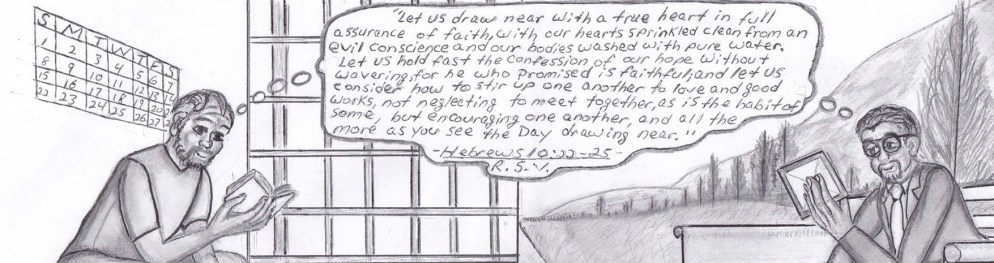
I live less than a hundred yards from Virginia’s Death Chamber. Death row is at another prison, but inmates are transferred here in a special van few days before their execution and we can see when it is parked outside the fence.

Tonight, over two thousand years ago, the Apostles locked themselves into an upper room and were in despair. Their leader and friend had just been brutally murdered and they had no anticipation of the resurrection. They probably sat and prayed, they may have hoped, they may have despaired.

Every time there is an execution here the chaplain is on call to minister to the condemned man in his last few hours. It is by far the most demanding job he has ever had in his decades of ministry. The night of an execution we are all on a modified lockdown status, and there is always a group of the believers who sit in their individual cells and pray. We pray for forgiveness for this man, for his faith, for the families of his victims, and for his family.

Ultimately, like Job, we do not know what happens after our death. But unlike those disciples of years ago we do know about the resurrection. We know what happened on Easter morning. I condemn the murder of murderers, I think it speaks to the depravity of our society, but I find strength in the word of the holocaust survivor Viktor Frankel: “We are the ones horrible enough to make a gas chamber, and also capable of walking into it with prayers and praise upon our lips.”

O God, creator of heaven and earth: Grant that, as the crucified body of thy dear Son was laid in the tomb and rested on this holy Sabbath, so we may await with Him the coming of the third day, and rise with him to newness of life; who now liveth and reigneth with thee and the Holy Spirit, on God, for ever and ever. Amen. BCP 170

Palm Sunday

by Matthew B. Harper

Psalm 22:1 – My God, my God, why have you forsaken me?

Throughout all of Jesus’ travels, through all of his earthly ministry, Jesus often went away to be alone to pray; but not so on this night. On this night, in the Garden of Gethsemane, Jesus kept his friends close. I believe it was in this garden, on this night, when our salvation was truly forged. Jesus pleads with God, he begs to avoid the horror of the crucifixion, and then he follows God’s will.

When I was preparing to come to prison I too surrounded myself with friends. We are together and talked. They helped me pack up some of my belongings for long-term storage, and I gave much away to them. The morning before I went away a group of friends came over to my house and our rector celebrated communion with us. Before leaving, my Love and I held each other close, and then I left. I went to prison with my head up, but it was only by the strength of my faith and my friends that I was able to do so. And when I broke down in fear, pain, and regret many times in the next few years, it was those friends that have given me strength, and taught me how to be a better man.

We are not meant to walk this journey through the world on our own. God has given us a great gift in the presence of each other, and we should draw strength from that. Even in the depth of his pain our Lord turned to us, lowly mortals, for companionship and comfort. Can we do any less?

So if it is listening when someone is in distress, holding someone when they cry, or simply standing beside someone when tragedy strikes, be there when you are needed.

Almighty God and everlasting God, who sent thy Son our Savior to take upon him our flesh, and to suffer death upon the cross: mercifully grant that we may both follow in the example of His patience, and also be partakers of His resurrection, Amen” BCP168

Saturday, Fifth Week in Lent

by Matthew B. Harper

Exodus 11:6 – Then there will be a loud cry throughout the whole land of Egypt, such as has never been or will be ever again.

The story of the Exodus is one of the foundational narratives of the Bible and the Jewish people everywhere. I have had the honor of being invited to share the Passover meal with a devout Jewish family, and it was a powerful ceremony of remembrance and deliverance.

But I have never been comfortable with the manner in which God delivered the Israelites. The Bible mentions repeatedly that it was God who hardened Pharaoh’s heart. God made his heart hard, and then punished him for having a hardened heart! And the final plague, the death of the firstborn of all Egypt, is a horror difficult to imagine.

But it is the punishment for their sinful state, and for the cruelty and oppression they inflicted upon God’s chosen people.

On this Day 2000 years ago Jesus prepared to celebrate the Passover meal. He remembered the sacrificial blood of the Lamb, even as he was about to become our sacrifice. The text of today’s reading reminds us that this great pain will never be again! The blood of their sacrifice saved the people of God in Egypt, and now all of us are kept safe by the blood of the eternal sacrifice – the Lord Jesus the Christ.

O Lamb of God that takest away the sins of the world,

Have mercy upon us

O Lamb of God, that takest away the sins of the world,

Have mercy upon us

O lamb of God, that takest away the sins of the world,

Grant us thy peace

Tuesday, Fifth Week in Lent

by Matthew B. Harper

Psalm 122 – I lift my eyes to the hills, from where will my help come? My help comes from the Lord, who made heaven and earth.

There are few more beautiful places on earth than the southern Appalachian Mountains. And down in those mountains is a small women’s university that has special significance for my family. Their motto is from the opening lines of this beautiful psalm.

As a child I used to ask my mother what the Latin motto meant, and she would refer me to this psalm. As I have aged, and especially during my incarceration, this psalm has taken a special place in my heart. When I look to the walls around me, I remember where my help comes from. When I feel like I will be pushed around, I remember who it is that keeps my feet firm. When I grow tired and feel defeated, I remember that the Lord who protects me never grows weary or sleeps. When I battle strong temptations, I remember who it is that will keep me from evil. And when my heart breaks over the length of years ahead of me in prison, I remember whom it is that keeps all my comings and goings.

A prisoner who loses his faith is doomed. He is doomed to fear, anger, and self-destruction. Whenever I feel overcome, I remember what and who my faith is rooted in. And I often recite to myself this psalm.

That it may please thee to have mercy upon all mankind, We beseech thee to hear us, good Lord” BCP152

Monday, Fifth Week in Lent

by Matthew B. Harper

Exodus 4:10-11 – But Moses said to the Lord “O my Lord, I have never spoken eloquently”… Then the Lord said to him “Who gives speech to mortals… Is it not I, the Lord?”

Moses had the same reservations that many of us have when we are called out of our comfort zone to serve the Lord. We are fearful and nervous. Our fear and our calling seem to be at war with each other. But, as one of our chaplains in here constantly reminds us “The Lord does not call the equipped, he equips the called.”

All to often we underestimate the gifts that we have been given, and we are afraid to step out in faith when we feel called. One of the greatest joys I have been a part of is when the leaders of the church can gather and discuss how to raise up new leaders, new teachers, and new readers. Many men feel called by God, but until we have a chance to call them forward, they remain silent. We underestimate the comfort and strength of the Lord that can speak through us.

And we underestimate how bad things can get. As a people we underestimate our ability to suffer, and we underestimate our ability to endure suffering. We do not realize what great strength we have to rely upon in the Lord.

God’s power isn’t coercive in our lives. God will call us, we must answer. In the Book of Revelation, Jesus tells us he is at the door knocking, but it is still we who must open the door and invite him in.

So when God calls you out of your comfort zone, trust and rely upon the Lord. When God calls you, God equips you.

That it may please thee to have mercy upon all mankind, We beseech thee to hear us, good Lord” BCP 152

Saturday, Fourth Week in Lent

by Matthew B. Harper

Psalm 108 – My heart is steadfast, O God, my heart is steadfast

1 Corinthians 13:8 – Love never ends.

The Bible seems clear that, more than anything else from us, God wants our steadfast love. God values our faith, and what is faith if not a steadfast heart focused on God.

It is possible, maybe even guaranteed, that you will love people who will hurt you, and you will love people who you don’t always like very much. We disappoint and hurt each other all too often, but steadfast love will endure all things and it never ends.

Some of my friends from before prison are still my friends during prison. They aren’t my friends because I never made them mad; because I never hurt them; or because they have always liked me. They are my friends because their steadfast love for me was greater than their anger.

In a world where divorce is rampant and destructively out of control, I have seen some prisoners’ marriages survive for years in spite of their hardships. The couples’ love is steadfast. There are some people who were in my life, and we loved each other dearly, but prison was too hard to stay in touch. The love has changed, but the love has never died.

God’s love for us encompasses all that we have done, and all that we might do. God’s love for us is steadfast. The Israelites constantly disobeyed God, and God remained steadfast in Love. I have disobeyed God in horrible ways, and God has never stopped showing me the mercy and grace of God’s love. The enduring power of God’s Love is the greatest force in all of creation.

Love is steadfast, anything less is less then love.

That it may please thee to support, help, and comfort all who are in danger, necessity, and tribulation, We beseech thee to hear us, good Lord” BCP 151

Friday, Fourth Week in Lent

by Matthew B. Harper

1 Corinthians 13:2 – And if I have prophetic powers and understand all mysteries and all knowledge, and if I have faith… but do not have love, I am nothing.

In prison I see what some people call “Christianity” in the way that they despise prisoners. They are quick to cut freedoms, programs, opportunities, and education. They scorn prison ministry as a waste of time. They believe that the Christian focus for prison has to be the ‘eye for an eye’ that appears in the Old Testament.

But in prison I have also found true Christianity. I have seen it in the work of the men and women who come into the prisons to teach the faith, to lift up the men to better lives, and to love them as God does. These people believe that the basis for ministry in prison is ‘forgive us our trespasses as we forgive those who trespass against us.” These people are not on any crusade to free prisoners from prison, just to free them from despair and sin.

Which side are you on? We are commanded to test all things by the spirit, and we are warned that many will come to us preaching the name of Christ, and they will be false messengers. We are taught to judge what is proclaimed by the fruit that it bears. The true work of God in the prisons brings forth repentance and newness of life. It brings forth not only clean and godly living on the outside, but it brings forth peace and joy. That is the true work of God.

Whatever your knowledge, whatever your faith, whatever your politics, whatever you have, do, or are; if you do not act out of love, then all else is as nothing.

That it may please thee to visit the lonely: to strengthen all who suffer in mind, body, and spirit; and to comfort with thy presence those who are failing and infirm We beseech thee to hear us good Lord” BCP 151

Lectionary: Fifth Sunday in Lent

by LA

Psalm 126

Psalm 126 bring me great joy every time I read it. Lent 5C Ps126I am reminded that even though I am in bondage now that not mean that there will not come a time when I am an old man sitting in a comfortable highbacked chair near a fire nice and warm, remembering the “bad old days” when I was a lousy prisoner and everything was hard and horrid. How back then it seemed I would never make it here and back to the love of my family.

I’m sure I would sigh at the memory and with my loved ones surrounding me in love and luxury I would entertain them with the tall tales of my prison days. Relaxing in quiet freedom and thanking the Lord for all he has done to carry me through those terrible times and restoring me to these real fortunes and riches.

I know that the above vision is an accurate portrait of my future and I have a hard time containing my excitement for its fulfillment, like a small child anxiously awaiting his parents to awake on Christmas morning. That anticipation of a better future helps me survive a horrible present.

Too often in times of trouble we forget that trouble passes and what is hard now is harvest later.


Tuesday, Fourth Week in Lent

by Matthew B. Harper

Genesis 49:29,33 – Then he charged them… When Jacob ended his charge to his sons, he drew up his feet into the bed, breathed his last, and was gathered to his people.

My sentence is very long. A few days after I was sentenced I spoke with my father over the phone. He told me that he might not live long enough to see me again as a free man. That is, to me, a terrifying and sobering thought.

My dad and I have always had a difficult relationship. I am now incarcerated, I am his only surviving child, and strangely we have a better relationship than any I can ever remember. And it is important to me to be in as deep a relationship with him as I can be. I read his books and talk frequently to him and my stepmother when he is in the country. Both of us value our relationship more than we did.

Dad has quit smoking and lost weight, but still lives a high-stress life. I hope and pray that we have time to once again go fishing and hiking; but his father died very young and I fear the odds are not in our favor.

I live my life with a lot of regrets—we all do—but let us not be allowed to regret damaged or broken relationships that can still be mended in the hear and now. As long as there is life for us, there is hope. If there are broken relationship in your life, reach out to heal them. If others reach out to you, accept them. In the Old Testament everybody seems to die peacefully and in the proper time, but in our lives it is seldom that way. You are not promised tomorrow, so make peace today. That will be something you never regret.

That it may please thee to inspire us, in our callings, to do the work which thou givest us to do with singleness of heart as thy servants, and for the common good, We beseech thee to hear us, good Lord” BCP 151

Fourth Sunday in Lent

by Matthew B. Harper

Luke 1:32-33 – …the Lord God will give to him the throne of his ancestor David. He will reign over the house of Jacob forever.

Jesus, the eternal Lord, sits upon the throne of David. Prisoners love the story of David. David the great king was also David the murderer and adulterer. In David’s story we see great sin, but also profound repentance and deep faith. On this the holy dynasty was founded.

Did David suffer for his sins? Of course. David lost his kingdom for a time, his family, and the son conceived in adultery died. But all of his suffering changed him, and it rooted his faith even deeper. David wasn’t strong enough to be used by God. He became weak enough.

Martin Luther King Jr. once said “the cross we bear always proceeds the cross we wear.”

We all bear our cross. We all sin. We all suffer. In well-to-do suburban churches this is not a common or easy truth, so learn it from those who know it intimately. We all sin and fall short of the glory of God. When we are able approach God with profound repentance, and are willing to remain steadfast in our faith, God will use us, and transform us. Everyone is capable of repentance, and from a position of profound repentance you can be weak enough to be used by God and raised to great heights.

Gracious Father, whose blessed Son Jesus Christ came down from heaven to be the true bread which giveth life to the world: Evermore give us this bread, that he may live in us, and we in him; who liveth and reigneth with thee and the Holy Spirit, one God, now and for ever. Amen” BCP 167