Second Sunday in Advent

by Matthew B. Harper

Blessed be the Lord God of Israel, for he has visited and redeemed His people.” (Luke 1:68)

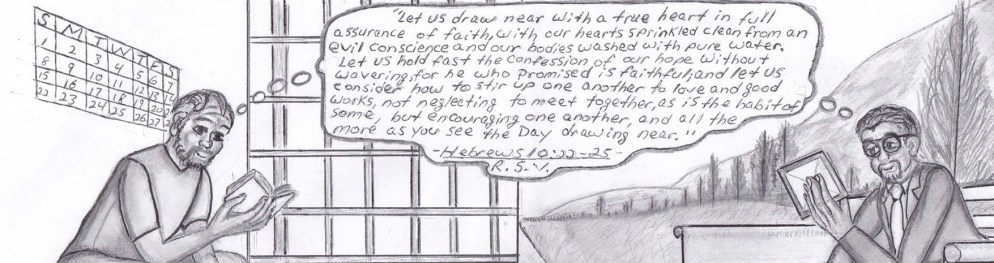
Redemption, for a prisoner, is often seen only as what happens when we are set free from these bars and fences. The world beyond these walls is idealized, and often idolized. After years of separation and deprivation it is easy to think that redemption will come when you get out and are able to experience the ‘good life’ once again.

When people are released from prison, and are able to realize some of their goals and lusts, they often find themselves just as empty as they were when they were in prison. Many of them come back to prison not because they wanted too much, but because they wanted too little. The ‘good life’ wasn’t very satisfying. We dreamt small dreams, and when we seize the dream we are often just as empty as when we began.

The things of our world are ultimately not enough to satisfy the deepest longings in our hearts. We are finite creatures, and we are made to know and commune with an infinite God. There is nothing in this world that satisfies that need, and there is nothing that is supposed to. God made us to yearn and long for communion with God.

Prisoners, crime victims, combat soldiers, victims of serious illnesses… all people who have been through extreme life changing experiences often realize how empty life is without God.

God is right here in our midst, and God envisions dreams for us that are so much greater then anything we could ever dream on our own. God does not require us to be good enough, or holy enough, only for us to be willing enough. When we seek our fulfillment in this world, we will always be empty, and when we seek our wholeness in God, we will always be filled.

Prepare the way, O Zion, your Christ is drawing near! Let every hill and valley a level way appear. Greet one who comes in glory, foretold in sacred story. (Hymn 65)

Welcome to Prison Lectionary!

What is Prison Lectionary?

Prison Lectionary is a virtual space devoted to biblical interpretation by artists and authors incarcerated in jails or prisons in the United States. The purpose of this endeavor is two-fold. First, Prison Lectionary will provide a forum for the voices of prisoners, who are the most authoritative witnesses to the violence of the Prison Industrial Complex. Second, Prison Lectionary will serve as a repository of information for pastors and others as they study the Revised Common Lectionary texts or other Scriptures.

What is the Lectionary?

The Revised Common Lectionary is a three-year cycle of weekly readings used to varying degrees by the vast majority of mainline Protestant churches in Canada and the United States. It is built around the seasons of the Church Year, and includes four readings for each Sunday, as well as additional readings for major holidays. During most of the year, the readings are: a reading from the Hebrew Bible, a Psalm, a reading from the Epistles, and a Gospel reading. During the season of Easter, the Hebrew Bible reading is usually replaced with one from the Acts of the Apostles.

Who may submit writing or artwork to Prison Lectionary?

Prison Lectionary will accept submissions from anyone incarcerated in the United States.

What kind of writings and art are welcome?

Prison Lectionary invites any interpretive writing or art that engages with a biblical text. Texts from the Revised Common Lectionary are assigned to specific authors, but anyone is welcome to choose a biblical passage and submit a one-page commentary, a drawing, a prayer, or a poem based on the text. In the future, we also plan to publish book reviews, poetry, devotions, and articles on prison ministry and the criminal justice system.

What kinds of writings or art WILL NOT be published on Prison Lectionary?

Prison Lectionary seeks to foster a safe and respectful space for dialogue around the Bible and issues related to Mass Incarceration. Therefore, Prison Lectionary WILL NOT publish anything that advocates violence or disrespects anyone on the basis of race, religion, gender, economic class, sexual orientation, political ideology, or physical condition.

How do artists and writers contribute work?

Prisoners must use this release form to submit their work:  Prison Lectionary Release Form