Lectionary: Third Sunday in Lent

by LA

Psalm 63:1-8

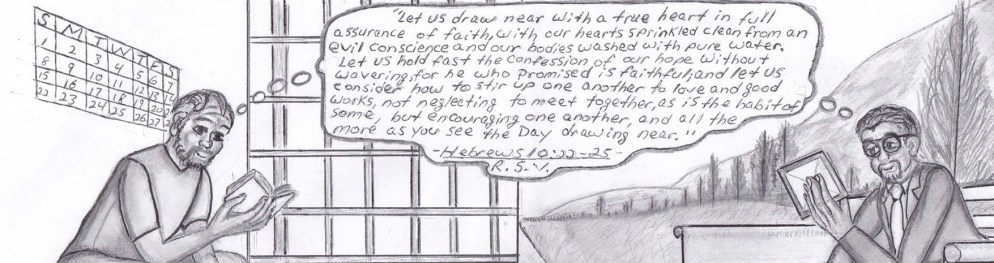
Psalm 63 is almost an identical recitation of my nightly prayers. David was in the wilderness of Judah when he composed this psalm and as anyone who has ever served a minute of time could tell you, prison is very much a spiritual wilderness. David speakers of searching for God and seeking him out as a priority in the first verse. Lent 3C Ps63 I myself must seek God that way. In my environment a person can very easily be pulled further and further toward debauchery and away from God by the unending siren’s call of immoral distraction. Without earnestly searching for God, minding and renewing ourselves of that effort each and every day, a person will become lost and worse yet may lead others astray as well.

The image David invokes when he describes his thirst for the water of God in a dry and thirsty land, is one that is relatable to any Christian prisoner in any cell house in America. But, like David I too have seen the glory of God and I too praise him with all my body, mind and soul.

In verses 3-5, David understand that just by praising God he is nourished and his soul is satisfied. If I have nothing else I have the ability to praise and worship god. That thought always brings shalom to my bone and peace to my anxiety.

When I read verses 6-8, I am reminded of the countless times when I am kept up at night by the noise and chaos of the cell house. I am forced to pray myself to sleep and I am grateful for it. “For what?” you might ask. No matter how clamorous or vexing the assault on my sanctuary of serenity may be, the Lord’s peace is equal to the foe. It’s a form of spiritual warfare. Night after night, spirits of torment manipulate tortured souls to draft others into their ranks. I lie on my bunk and like David meditate on the Lord in the night watches. I pray for those poor unfortunate souls who are so agonized nightly and it forces me ever closer to God each night. And for that I am extremely grateful and I rejoice.


Ash Wednesday

by Matthew B. Harper

Matthew 6:20-21 – …Store up for yourselves treasures in heaven…for where your treasure is, there your heart will be also.

In the Sermon on the Mount Christ is imploring us not to value the things of the world, and not to live according to the rules of the world. Christ has come to us to remind us to live our lives for the things that matter. This is a powerful reminder as we begin the period of Lent. In this full passage we are reading about fasting. For Christ does not ask us to fast, but simply tells us what to do when we fast. It is taken as a given that we will fast for periods on our walk.

Fasting is not about punishing ourselves; it is about showing our devotion and obedience to God. Fasting is a tool God has given us to help correct and control the urges that are out of control. Fasting is a way that we put aside those things of the world so that we may focus more fully on God. To let lose from those things that will pass away, and hold tight to those things that are eternal

So when we read these words of Matthew, we are not being told to forsake the world, or to reject it. Instead we are told to hold dear those treasures that are of God, those that will endure for all time, and to let go of everything else. St. Paul reminds us what those things are: “Purity, understanding, patience and kindness, in Holy Spirit and sincere Love, in Truthful speech and in the power of God.

“Create in us new and contrite hearts, that we, lamenting of our sins, may obtain, by the God of all mercy, perfect remission and forgiveness.” BCP166

Epiphany 3C

by Matthew Harper

January 24th, 2106

Nehemiah 8:1 –3, 5–6, 8–10
Psalm 19
1 Corinthians 12:12–31a
Luke 4:14–21

What does it mean to be The Body of Christ? What does it mean to love one another and still welcome into our midst the stranger? When Jesus announces Himself amongst us, will we be able to receive Him?

One beautiful gift of a prison church is its diversity. Prison is full of men of every age, race, and background. Some have grown up here, some have grown old. we have doctors, the mentally disabled, and everyone in-between. Our church has the most diverse congregation I have ever heard of.

But our diversity isn’t a magic cure-all for sin. Into this community each individual brings their own gifts, and the baggage of their own sin. We judge, we gossip, and struggle. We are a holy work-in-progress. As much as we learn from one another, and as deeply as we love, we also wound.

I am blessed to be a part of another congregation, at Saint David’s Episcopal. They befriended and welcomed me, even though it hasn’t always been easy.

Several years ago Saint David’s, as a congregation, identified and named the core values of their community. Among those values was “inclusion.” That is a good Christian value, one comfortable to proclaim but often uncomfortable to live. When questions about my joining the community were raised, they challenged them to live out this value. They choose to include me. I believe it has enriched all of us.

Diversity and inclusion are hallmarks of a Christian community, but they can be a challenge we struggle with. In his first letter to the church at Corinth Paul taught about the struggle. Chastising jealousy and envy Paul reminded them, and us, that our unity is as The Body of Christ, and it is a unity that requires and honors a diversity of individual identities and gifts.

Finding community with someone different from ourselves takes work. honoring each others’ gifts demands humility. Living in a prison cell with another person demands accommodation. Often I have worked to find a cell-mate similar to me, but over the years I have also had many cell-mates far different. When I was young, some were old; I am white, some have been black; I am a Christian, some have been Muslim; and as I grow older, some are now young. To find our common identity demands that we see with more than our eyes and hear with more than our ears. It demands the faith to look and listen to one another with our hearts.

Honoring Christian community in the face of disagreements on challenging social issues can be even more difficult. Recently an international prison ministry to which I have devoted 16 years of love, prayers, and service faced this very question. Challenged with how to move forward and honor our diversity, they retreated. Struggling to be The Body of Christ, they chose amputation.

Doing so they rejected not only me, but my entire faith community and denomination. They did this because we chose to stand beside and honor the work of God in and through a member of our community who is a married lesbian.

Amputation. After 15 years of war in the Middle East we don’t have to look very far to see wounded bodies. Heroes like my step-brother are the wounded warriors in our midst and show us the challenges. What if The Body of Christ looked like that? How would we walk with no legs, hug with no arms, or love with only half a heart? Who would we be?

Luke’s Gospel shows us Jesus returning to the place he grew up, ready to begin His incarnate ministry. With the words of Isaiah He proclaims God’s work. The results are…. underwhelming. The community chooses to retreat into familiarity, and it blinds them to Christ’s identity and mission.

Familiarity can be a gift, but it can blind us to the presence of God. We cannot always retreat to what is comfortable. Our diversity is what keeps us open to the new works God is doing. Only when familiarity and diversity balance and challenge one another can our communities flourish. Together we grow, together we hear God. We must be ecumenical; we must be inter-denominational. We must honor and welcome the unique gifts we bring. We must welcome the stranger in our midst. We can’t just say we are The Body of Christ. We have to live it.

Epiphany 2C

by Matthew Harper

January 17th, 2016

Isaiah 62:1 –5
Psalm 36:5–10
1 Corinthians 12:1 –11
John 2:1 –11

Today is all about weddings. From the wedding poem in Isaiah to Mary’s plea during the wedding at Cana, Marriage is on our mind.

Throughout Scripture God uses the imagery of weddings to describe our relationship. Weddings speak to us of commitment, love, unity, and procreation. Despite how our earthly marriages fall short we are continually struggling to find the pure ideal that reflects God’s plan.

Isaiah’s poem is striking because of the deep longing it reveals on the part of the groom. Scriptural illustrations make it clear that we are the bride, and here we see God, the groom, who is yearning, working, and reworking us so that we might be vindicated, found worthy, and crowned.

Weddings are a big deal. In biblical times the wedding celebration was a sign of love and commitment, but also of family honor and the value and honor due the bride. We need to be vindicated because on our own we are far from worthy.

It is this family honor that is at stake for Mary. John’s gospel shows us Jesus and Mary at the wedding of a family or close community member. The size and quality of the party mattered, and demonstrated value and esteem. To run out of wine during such an occasion would have been a point of deep dishonor to the family and a devaluing of the bride.

Mary is focused on this honor, but Christ’s vision is larger. Christ has before Him the full vision of His life and ministry, and yet He is not deaf to His mother’s plea. Are His words a rebuke to her? Yes, in part, to create distance. Christ acts, but at His own choosing and not simply at His mother’s behest.

God’s gifts are always given by God’s own initiative, for God’s glory. We benefit, and we rejoice, but always to God’s greater purpose. All of today’s readings hold that as a central theme. When we have nothing left but loss, when all that we have and are has run out and we are left with the empty water of ritual, the sweet wine of the Gospel refreshes us and leaves us drunk on joy.

The patriarchy and honor-rituals of biblical weddings are foreign things we have mostly grown out of. They are best left in the past. But we can see in the imagery a powerful analogy of our relationship with God, and a vindication of our identity.

The movement from loss and ritual to joy is the testimony of every believer. It is not only the prisoner who knows destitution and rejection, it is not only we who need to be set right. All of God’s creation needs the gifts only God can provide.

God’s gifts are not charity. Each of the destitute has, at one time or another, received charity. It can feed your body, but not your soul. The yearning we hear in God’s wedding poem isn’t simple philanthropy. It’s Love. Our promise of Hephzibah, of Beulah, is a promise of Love, of Marriage, of a God who loves and delights in us.

Philanthropy, like the Canaanite Cults of Isaiah’s day, offer visions of fertility, but marriage is more than that. What God yearns for, and offers, is a fertile marriage of love and delight.

This celebration transforms us. The words of Isaiah promise a remaking, a vindication, and Paul’s letter to the Corinthians discusses the many gifts God gives and how they work together for our benefit and God’s glory. We will be a bride crowned with a royal diadem, a highest honor given not because of who we were but because of who God is and what God has made us.

Every bride is beautiful. The love of the groom has the power to transform her in the eyes of all present. It has never been that beautiful people are loved, but rather that love itself makes us beautiful. When we acknowledge and live in the overwhelming Love God has for us, we will be transformed.

You are loved and you are beautiful
You are married to God
Let the wine flow.

Let the party begin.

2nd Sunday of Christmas/Epiphany Sunday

by CM

Psalm 72:1-7, 10-14

Our Savior entered the world as a solution to a problem that a significant portion of the people in power didn’t even realize existed. Those who has the scriptures, those in positions in the government, those with the resources and the means to solve the problem never deployed them because they were blind to it.

Here comes Jesus, born King yet He carried a mandate from on high to bring a solution to a problem that was so prevalent that the powers that be sought to slay Him even as a baby. Why? Because His life was meant to expose those in authority, those in power, as the source of the problem.

Our reading identifies a number of issues: lack of justice and disenfranchisement of the poor, oppression, hopelessness, cruelty. These conditions are all results of sin. However, they lack the abstract notions of what constitutes one’s individual nature and squarely categorize the issues involved in the way the powerful treat the common man. It was the state that took issue with the life of Jesus, the religious folk who pledged loyalty to the state, “We have no king but Caesar.” Why? Because they couldn’t see THEMSELVES as the problem.

Being that those same problems still exist and persist, what are we not seeing today in relation to their presence? Jesus exposed the systematic injustice, unrighteousness, corruption, cruelty and evil in the simplicity of the fact that they killed him! Sometimes people have a tendency to gloss over that fact.

What does it say—right where the rubber meets the road—about ANYONE, ANY SYSTEM, that kills a person? Let that word sink in for a moment. A PERSON such as Jesus. Not, “Son of God,” not “The Christ.” We have to ask the question, was Mary’s baby boy a bad PERSON? Because make no mistake about it, in a very NON-ABSTRACT way, that is who they—the powerful, the ruling class, the government—killed. And unless he was at the very least a bad person, they killed him wrongfully.

Are we “divorced” from seeing the same today? Have we forgotten that Jesus said something about how the way we treat “the least of these” equals how we treat Jesus? If we take issue with seeing Jesus as simply being a Person, it may indicate a lack of the ability to see the downtrodden as Jesus.


“Time-Released Details” (1st Sunday after Christmas)

1st Sunday after Christmas Day – December 27

1st Samuel 2:18-20, 26; Luke 2:41-52; Colossians 3:12-17

“Time-Released Details”

by CM

A parallel between the Old Testament reading and our Gospel reading is that we’re observing a moment of boyhood in the lives of two individuals who are intrinsically linked across the span of many generations: Samuel and Jesus. One eternally occupies the Throne of David as King of Kings and Lord of Lords, our Savior Jesus; while it was Samuel who became the man that inaugurated the line of Israel’s royalty and anointed its first two kings.

We also see the hearts of two mothers—Hannah and Mary—women who have prayed, dedicated their lives to faithfully carrying out the requirements of the law as a result of their devotion to God, and two women who have divine insight into the destiny of their special boys, even if they lacked the details. And it’s in the lack of details that the real value of the faith journey is revealed.

These mothers, looking at their boys, both of them products of God’s word to them in “time release” form. Who can say with certainty what the details of a boy’s manhood will look like? Yet, as is pointed out—in 1st Samuel 2:26, in relation to Samuel and Hannah; and in Luke 2:52, in relation to May and Jesus—both moms watched their boys grown in stature and in favor with God and men as they transitioned from boyhood to manhood.

So I ask you now, what has been produced in your life pursuant to your relationship with God which unites you in your experience of that production with Hannah and Mary? What has God brought into your life on a “time release” basis? Something that requires a period of maturation?

In what ways may you yourself be that time-released gift to humanity from on high? In what ways have you ever considered that the promise and purpose of your own life may be directly linked to the life of another across the span of generations?

It is this consideration that brings forth the sacred in your life. Embrace this truth and sanctify this reality by doing all things, be they in word or deed, in the name of the Lord Jesus, as is pointed out in our epistle reading, Colossians 3:17.

You can imagine, coming from the perspective of an incarcerated man, scriptures that highlight transitions across the passage of time—“time-release” workings of the hand of God—are particularly encouraging. May the areas in your life that require a period of maturation be seen in new light, and as our two mothers in these readings, keep these things in your heart and be encouraged too.

Before and After (Christmas Day)

Christmas Day

Hebrews 1:1-4 (5-12)

“Before and After”

by CM

Have you ever known a person who was stuck in the past? Everything they say is about, “The good old days.” People constantly caught up in nostalgia, pining for the comforts of yesterday, confusing “old-school” with “old-fashioned.” Just because an old pair of shoes is still comfortable doesn’t mean that they aren’t worn out and as with all things, change is inevitable.

Our text is written fro the benefit of those who have become comfortable with what was. People who are devoted to God in the context of a past deliverance. We have come to love the Lord and have a “testimony” to the truth of what God can do. We remember our former state, our particular sin, and in that deliverance we KNOW God; for it was through that experience that God spoke to use… in times past, our Before.

Our text illuminates the validity of a “before” experience. God spoke in time past through the prophets, but in these last days, he speaks through his son Jesus—the “After.” Many in the first century and up to this very day have a problem with the change that Jesus brought into the world. They were, and are, stuck in the before, but the real question is this. Does a person’s choice to be suck in the past equate to God remaining there too?

As we celebrate the birth of Jesus and acknowledge God’s transition in his means of communication from the old to the new, let’s open ourselves up to experience God work in our life in a new way. Let’s open ourselves up to a new “After” and be thankful for God’s “Before.”

The opening words of Psalm 98 read, “O sing to the LORD a new song.” In Jesus we have cause to. In all that we testify to, all of it is “before.” Move with an open willingness into the glorious “after” of what God wants to deliver you not just from, but to.

Manger Maker (Christmas Eve)

Christmas Eve – December 24th

Luke 2:1-14 (15-20)

“Manger Maker”

by CM

The Nativity story has always held a special place in my heart. It’s a scene in which the most glorious of all existence enters the turmoil of a chaotic creation. And in the duration of time that encompasses this event, peace and joy enfold all of space, all of time, and it’s all because of a baby named Jesus who was wrapped in swaddling clothes and laid in a manger.

There is a host of individuals who helped make this moment possible, each on divinely situated to play an important and specific role to bring about God’s designed purpose. Of course, we have Mary, whom we all call blessed. There’s Joseph, Mary’s husband, and descendant of the House of David. Caesar Augustus, for only an Emperor could issue a decree to all the world that would compel Joseph to make the trip to Bethlehem. We need a historical reference point to narrow down the period of time, so we have the governor of Syria, Quirinius. We have the shepherds in the field to bear witness to the event, the angel, and the host of heaven to praise and worship. All of the these people are identified so we’ll have contextual depth and texture for this story. But there’s one more person, one whose touch is so important that without him we’d have a totally different accounting of this story. Can you identify him?

The fact that Joseph and Mary were turned away from the inn shows that they didn’t have the manger on their minds when Mary’s time to deliver came. That means that the manger just so happened to be there, or was it really that much of a coincidence? Someone built it, someone gathered the materials and used his skills to construct the place where Jesus would be born, where the shepherds would find him, and a place where, in an imperfect world, perfect timing and placement were demonstrated by an unnamed craftsman, whose importance was so vital that God personally commissioned him to do so.

Some of you who may be tempted to esteem your value, your importance, your vital presence and dynamic contributions as being less significant than those of the “named” stars of the show. Consider the world into which Jesus was born and the first place he found prepared for him. Did the “Manger Maker” know the significance of his work project at the onset of his undertaking? Probably not. But God did. And while we don’t know that craftsman’s name, God does. And in that example, recognize the fact that your own worth is measured by your faithful dedication to perform and the fact that God knows your name.

For it is in such, I believe, that we find a long list of names. Names of a silent majority who make sure God’s projects come to pass, a list whom Jesus will personally greet with a warm embrace and add the words, “Well done, my good and faithful servant.”A simple, yet profound, “Thank you.”

Fourth Sunday in Advent

by Matthew B. Harper

For God sent the Son into the world, not to condemn the world, but that the world might be saved through Him. (John 3:17)

All too often when people think of Christians, they think of condemnation. They picture a God who comes to condemn them and the world. We are all sinners, and in prison the reality of our crimes and wrongdoings is ever present to us. We are living in punishment, we are expecting condemnation, and we condemn ourselves. But what we never expect is the radical love of Christ.

In all of His earthly ministry Jesus never condemns people for being lost, sinful, or broken. The harsh words that Jesus does speak are reserved for those who abuse and misuse their positions as ministers and priests. God speaks only words of love and invitation to His children. The Bible is handed down to us as a great gift, not a weapon to use on each other.

Many of us in here have been abused and condemned by Christians. Instead of seeing examples of Christ’s loving presence, we have only seen examples of human weakness and animosity. This is not the Gospel message.

God loves us so much, in our sinfulness and brokenness, that he sends his son to us to invite us back into a relationship with Him. Christ’s birth was foretold, and so was Christ’s death on Golgotha. God gave His son to us, knowing we would reject and kill Him. This is how much God loves us.

Dare we love each other as much?

Dare we not.

O come, thou wisdom from on high, who orderest all things mightily; to us the path of knowledge show, and teach us in her ways to go. Rejoice! Rejoice! Emmanuel shall come to thee, O Israel! (Hymn 56)

Thursday, Third Week in Advent

by Matthew B. Harper

Then all those maidens rose and trimmed their lamps…Watch therefore, for you know neither the day nor the hour. (Matthew 25:7,13)

Throughout the Gospel Jesus often likens the Kingdom of God to a lamp burning in the darkness. He calls it a lamp and a light, but as a child I knew it as a candle.

On Christmas Eve the church services would often end in darkness. The choir would light a candle, and the light would spread. The flame would be passed through the congregation, and the light would grow and spread more. If a candle was blown out by a chance gust, it was quickly relit from another candle in the community. In the deepest darkness of a cold winter night the warm glow of light would encompass the church as the voices sang a beautiful and old hymn. Christ was here, Christmas was here, and the celebrations could begin.

It is dark at night in the desert. Away from the city and the community the night becomes heavy and oppressive. St. John of the cross described his desert experiences as the ‘dark night of the soul.’ Prison is just such a darkness for me, and we all have darkness like this in our lives.

Into all of this darkness comes the light of Christ. The kingdom burns brightly with a light that cannot be put out, only spread. As the community grows in faith and joy the light glows brighter. The light always defeats the darkness. Always.

Even in prison it is a holy night.

Silent night, holy night, all is calm, all is bright. Round yon virgin, mother and Child! Holy infant so tender and mild, sleep in heavenly peace, sleep in heavenly peace. (Hymn 73)