Thursday after Ash Wednesday

by Matthew B. Harper

Habakkuk 3:18-19 …I will exult in the Lord God of my Salvation. God, the Lord, is my strength…

I lay my weakness before the Lord, and I rely on His strength. But it is very telling that the words of Habakkuk come after affirmations of the Lord’s judgment, and the Lords coming destructive powers. We follow a just God, and Justice requires punishment.

Paul puts aside the things of his past, so that he would not rest on his past labors, but would always work for new tasks. But putting aside the things of the past also means leaving our failures behind. It means embracing the forgiveness of God, and allowing God to heal the things that are behind us. Paul was a murder of Christians many times over, but that was in his past. He is always mindful of his sin and his sinful nature, but when he was following God, he was trusting God. He could not change his past, but he made sure that God filled his present, and guided his future

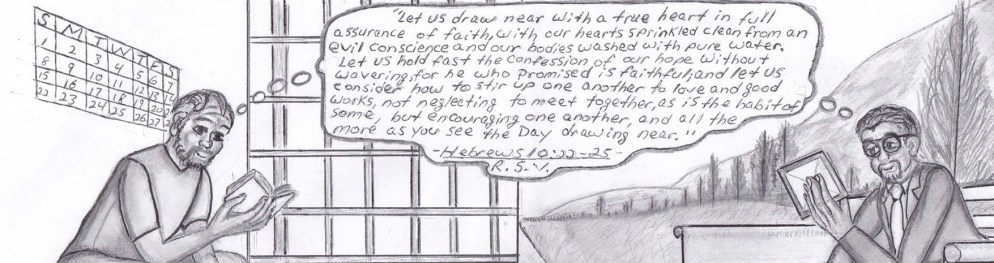
In Prison we live with this same burden. My past is dominated by the guilt of horrible crimes, and my present is consumed with the regret and atonement for those things. As I have become one of the mature in Christ I have striven, like Paul, to turn my focus to “reaching forth unto those things which are before.” To allow God to fill my present, to allow God to focus my future, and not to live without hope, crushed by what I have done. I can only leave that to God, focus my face forward, and rest and rely on the strength of the Lord.

“O God the father, Creator of heaven and earth,

O God the Son, Redeemer of the world,

O God the Holy Ghost, Sanctifier of the faithful,

O holy, blessed and glorious trinity, one God,

Have mercy upon us.” BCP 148

Ash Wednesday

by Matthew B. Harper

Matthew 6:20-21 – …Store up for yourselves treasures in heaven…for where your treasure is, there your heart will be also.

In the Sermon on the Mount Christ is imploring us not to value the things of the world, and not to live according to the rules of the world. Christ has come to us to remind us to live our lives for the things that matter. This is a powerful reminder as we begin the period of Lent. In this full passage we are reading about fasting. For Christ does not ask us to fast, but simply tells us what to do when we fast. It is taken as a given that we will fast for periods on our walk.

Fasting is not about punishing ourselves; it is about showing our devotion and obedience to God. Fasting is a tool God has given us to help correct and control the urges that are out of control. Fasting is a way that we put aside those things of the world so that we may focus more fully on God. To let lose from those things that will pass away, and hold tight to those things that are eternal

So when we read these words of Matthew, we are not being told to forsake the world, or to reject it. Instead we are told to hold dear those treasures that are of God, those that will endure for all time, and to let go of everything else. St. Paul reminds us what those things are: “Purity, understanding, patience and kindness, in Holy Spirit and sincere Love, in Truthful speech and in the power of God.

“Create in us new and contrite hearts, that we, lamenting of our sins, may obtain, by the God of all mercy, perfect remission and forgiveness.” BCP166

40 Days of Lent: Different Shoes, A Common Path

by Matthew B. Harper

Walking the Path:

an introduction

It is often said that you never truly understand a man until you walk a mile in his shoes. This is probably true, but it undervalues empathy and compassion; and it undervalues the gifts of God. God knows us better than we know ourselves, and creates understanding in our hearts for our brethren. My shoes are ones I would not wish on anybody; but even though we walk in different shoes, we walk a common path before God.

The walk with our Lord is a daily walk and a constant cycle of rebirth. It is a process of getting up every day and beginning again to walk the path that is put before us. It is a daily discipline of struggles and reassurances, of doubts and faith. It is a walk that grows easier with practice, but it never grows easy. During the days of Lent, I want to walk this path with you, and I am privileged to be invited into your walk.

Lent is the period of preparation. From the first time when the earliest Christians observed Lent, it was the time when the community brought in new brothers and sisters, taught them the ways of the Lord, and prepared for the Easter celebration. During Lent the new believers would spend the time studying and praying and on Easter morning they would experience their own resurrection just as Christ did. They would be baptized and share the communion for the first time.

Easter is what it is all about. As C.S. Lewis once said, “Without the resurrection, all that we do is in vain.” The resurrection of our Lord on Easter morning is the confirmation both of Christ’s divinity, and the triumph over death. It is a powerful declaration of God’s love and sovereign power over all of creation. Ours is an Easter faith, the faith in the redemption made possible by the resurrection.

I have chosen to write my devotionals during the period of Lent, because it is in the period of lent that I live. Lent is the preparation, the period of repentance, the period of learning. We begin lent on our knees marked by ashes. We bind ourselves with the marks of mourning, and make ourselves very mindful of our sinful and fallen ways. We observe lent through various ways of fasting and serving. We fast to set right our bodies and our urges, and we offer our service in grateful response to the grace given to us. Ultimately, in the Easter feast, we celebrate our own rebirth just as we remember our Lord’s.

The lives of prisoners are nothing other than parables of Lent. I was brought to my knees in mourning and repentance before the Lord. And just as my life is barren of the pleasures of life, it is nothing other than a type of fasting. This is a period of building up, a period of learning, and a period of service. The rebirth of these past many years is of God and is from the depths of my own soul and life. Years from now the day will come when I will walk free from this place and experience another kind of rebirth. My time here in prison is my own Lent, an in-between period of growth and repentance.

Lent is the hard part. We are born anew in Christ when we first come to repentance and cast our cares upon the Lord. We place our faith in the Lord, and we start down a new path. It is a walk that ends in Heaven, but one that is often difficult to walk. Lent is the humble and dark period, the dark night of our soul; and yet it is in the darkness that the light shines the brightest. We must learn from the Lord, and from the bible, and we must have the courage to follow the way The Lord leads. This is, for all of us, a daily struggle and a daily journey. We will fail at these tasks, and, as the Benedictine monks teach: “each day we must begin again.”

This is the hard part: to walk each day upon the path The Lord is leading us upon.

This is written for prisoners and free people alike. So your path may be very much like mine, or very different. But ours is a common path of discovery: a path of repentance, sanctification, and the uplifting and life sustaining power of God’s love. And if we walk in different shoes, that does not lessen our empathy or our compassion. We are simple brothers and sister, on a common journey.

I encourage you to approach Lent with reverence, and to observe it with fasting of some way. Maybe you need to fast from some type of food, from some type of addiction, from some pleasure, or some indulgence. The important issue is that you take some step to ensure that your walk is more as God intended it to be, and that you free yourself from any hold or addiction that the world might have on you. It is not that there is any great evil in any pleasure, for they too are gifts from God; but it is we who must be the master of our urges, and not our bodies. Periodically abstaining from things can, of occasion, help us to keep our lives in proper perspective. And if we choose to end our fast at Easter, then we will discover a new pleasure as we rediscover these gifts. So if your fasting is from chocolate or meat, cigarettes or sex, from television or books, I encourage you to observe Lent in this way.

But to follow in the ways of God is not just to put down, it is also to pick up. I encourage you to observe Lent by taking upon yourself the things that are of God. Maybe it is the daily study and devotion that we will do together, maybe it is the study of some other Christian learning (I recommend C. S. Lewis, Madeline L’Engle, Alister McGrath, Donald Miller, or Lauren Winner.) maybe it is some godly service that you are being called to do, maybe it is just that you need to learn to be kinder in your words and actions towards others. Whatever it may be, there are surely ways that you can allow God to build you up in your Christian life. I encourage you to take upon yourself some new discipline in your walk with Christ.

Lent is a time of spiritual journey, but part of that is about these practical steps. Our spiritual journey must be made manifest in our lives in some way. Ours is not just beliefs, it is also acts. We must live in the gratitude that Grace has given birth to in our lives. And it serves little purpose to be built up in the ways of God, if you do not do something with it. What point is it to learn if not to teach; why pray if not to intercede; why grow if not to mentor?

So I offer up to you what little wisdom and experience God has given me. I hope we can walk our journey together, and I hope my life can offer you insight into your own.

What follows are 48 devotionals: one for each day of Lent from Ash Wednesday until Easter, including the Easter Vigil. All scripture references are taken from the New Revised Standard Version of the Bible, but any good translation will suffice. I encourage you to read the Daily office readings, read the devotional, and then spend a few quiet moments in prayer meditating on what God is speaking to you on this day. At the end of each devotion are some words of prayer from the Book of Common Prayer (1979).
Epiphany

by Matthew B. Harper

When Abram was ninety-nine years old, the LORD appeared to Abram, and said to him, ‘I am God Almighty’ (Genesis 17:1)

There comes a time in all of our lives when we have to gamble. We have to take the step out in faith, and say: “What if this is all really true?” So we step out over that cliff, and take our great leap of faith, and we are caught in the hands of God. And then the whole world is different and we are reborn a new creation.

During Christmas there are many gifts of jewels and precious metals given. But in order to forge the gold and silver there is a smelting process that it must go through. The metal is heated and melted so that the impurities will rise to the surface. Then the smelter will rake this dross off the surface to purify the metal. The metal is considered pure when the smelter can see their reflection in the metal.

The gold and silver that is given as gifts is precious, but how much more precious are you. When you are caught in God’s hands you will be cherished, and like that metal you will be purified. You may find things rising to the surface, but only so God can deal with them and heal you. You will be worked and purified until you reflect the image of God. Until, when someone looks at you, they see the glory of God.

There is no source of light that is as bright and wonderful as the star that Christmas night. Not just the star in the heavens, but the star that was in the manger. When we have been worked and purified in God, then it is not our lights that shine, it is we who have been able to reflect the light of Christ.

So we must be willing to step out in trust for God. We must be brave enough to take that first step and then be caught. We must work to prepare a highway in our lives, for God shall surely travel upon it, and meet us there.

What star is this, with beams so bright, more beauteous than the noonday light? It shines to herald forth the King, and gentiles to His crib to bring. (Hymn 124)

12th Day of Christmas

by Matthew B. Harper

For you, O LORD, are most high over all the earth; you are exalted far above all gods. (Psalms 97:9)

How often do we really put God first? How often are we willing to do the difficult things that the Bible speaks of? How often are we willing to be loving, and not just always ‘right?’ How often are we willing to put forth our hand in love towards those that seem the most unlovable? What has our encounter with God done to us?

During Christmas we recall the humble shepherds who came to Christ’s infant bed; and I often wonder what happened to them afterwards. The gospels only record that the shepherds left the infant Jesus to go forth praising what they had seen. To truly encounter Christ changes us. Whether we accept or reject the offer of mercy and grace, our encounter with the risen Lord will have an impact on our lives, in each and every area.

In prison there is always someone watching. There are always people wanting to see if the changes are real, and if they are lasting. Because some people leave prison, and soon return bringing with them new crimes, new time, and new victims. But there are other men, ones for whom everything becomes different in a wonderful way. These men are able to go forth, in prison or out of it, into a transformed life. They are healed, and in their new life they can often become healers. This can only be by the power of God.

With God there is no addiction that cannot be overcome, and there is no idol that cannot be torn down. The God most high overcomes all. When we put God first in our lives then all things are made new, and the difficult is not so difficult. We are filled with God’s love and it spills over into loving others.

The snow lay on the ground, the stars shown bright, when Christ our Lord was born on Christmas night. Venite Adoremus Dominum. Venite Adoremus Dominum. (Hymn 110)

11th Day of Christmas

by Matthew B. Harper

And the name of the city from that time on shall be, The LORD is There. (Ezekiel 48:35)

The gift of presence is one of the greatest gifts that we can ever give each other. I think to all the moments when we tried to express our lives and relationships in words, and found them totally inadequate. Sometimes there aren’t words. All we can do is sit and be with each other, to hold each other in our tears and pain, and celebrate together in our love and joy.

But true presence in relationship requires no barriers, no betrayals. It requires that we are open and loving, vulnerable and trusting, and that can be more difficult than it sounds.

In living with and loving my fiancé I found something amazing and wonderful beyond anything I had known, but it was founded upon a deep betrayal. Already guilty of my crimes I lived in a lie that I was innocent for many years. Despite all that we did for each other, despite a love that overwhelmed us, I could never truly be present for her. I was always hiding something, always holding back. There was a hindrance, a burden, upon our love. It was a deep betrayal, and hurt her dearly.

To hear that God is an ever-present God is to know not just that God is with you always, it is also to know that there are no separations and no hindrances to love. There is a total openness to us in God’s love. We have wounded God and turned our backs to God, and there is still a constant and ever-present accepting love. In a deep and accepting love we find the calm assurance not just to be more fully who we are, but also to love back with wild and wonderful abandon.

Be present to those you love, and love them with a joyful and reckless abandon, hold nothing back – for that is how God loves you.

To you, in David’s town, this day is born of David’s line the savior, who is Christ the Lord. (Hymn 94)

10th Day of Christmas

by Matthew B. Harper

The LORD is my shepherd… (Psalm 23:1)

It is comforting to remember Christ the Good Shepherd; but have you ever stopped to think what it means to be his sheep? Sheep are disobedient, and unruly animals. Sheep are smelly and dirty, and they are not the cute animals that they appear to be. Sheep are often very human. But it is these creatures that need a shepherd. If sheep were clean and well disciplined, then they would not need a shepherd to look out for them and guide them. Humans are like sheep, and we need a shepherd.

The danger comes often when we are so eager to follow, that we will follow anybody. When people feel marginalized, depressed, and afraid they will grasp at any straw, they will follow any shepherd. In prison, when men are at their lowest, I have seen them embrace anything and everything. We have groups in prison that try to cling all kinds of sects, schisms, cults, and other faiths. It is not always enough to know you are lost. But Christ is real, Christ that has the power to come to us and search us out.

We come to know Christ most truly, and most deeply, when we are lost. We learn about God’s Love when we allow God to love us when we feel unlovable. I wish there was an easier way to learn to trust God, but for many of us it had to be a rocky road to redemption. We all, like sheep, have gone astray. But it is Christ who has sought us out and brought us home.

I have never been so far from everything I love. When the world is difficult for us, God uses those times to love us more intensely, and to sustain and protect us.

It came upon a midnight clear, that glorious song of old, from angels bending near the earth to touch their harps of gold; “Peace on earth, good will to men, from heaven’s all gracious King.” (Hymn 89)

9th Day of Christmas

by Matthew B. Harper

In his days Judah will be saved and Israel will live in safety. And this is the name by which he will be called: ‘The LORD is our righteousness.’ (Jeremiah 23:6)

There is no one without sin, says Paul, no one who is righteous. And I don’t know of a church where that is more clear than on any given Sunday night here in prison. If there was a gift that comes from prison faith, it is that it is grounded in the sure knowledge of our total unworthiness, and the sure knowledge of God’s loving graciousness.

I received a letter from a friend who lives in Texas yesterday. An ex-con herself, she and her husband work full-time and also minister to over 75 inmates around the country as part of the motorcycle ministry that they ride with. She is a woman devoted to God and ministry, and in her letter she thanked me for being such a blessing to her. Talk like that makes me uncomfortable.

If I were a man who thought myself righteous I could pat myself on the back and say “Of course, after all – don’t you know who I am?!” But the problem is that I do know exactly who I am. I live with me. I know all of my failings, my thoughts, my regrets, my wrongs, my sins. I am very unrighteous. And yet I trust my sister when she is telling me that she has been blessed through our friendship as much as I am.

To that there is only one response. If it isn’t me, and she would deny it is her, then it must be God. My only response can then become: “Of course, after all – don’t you know who God Is?!”

God chooses us, God loves us. God doesn’t just bless us, God uses us to bless others. I am not righteous, but God is. Praise be to God.

Sing, O sing, this blessed morn, unto us a child is born, unto us a son is given, God himself comes down from heaven. Sing O sing, this blessed morn, Jesus Christ today is born. (Hymn 88)

8th Day of Christmas

by Matthew B. Harper

He said, “I am the LORD who heals you.”(Exodus 15:26)

Healing is a difficult subject for every Christian. We know that all of creation is God’s, and we know that it is fallen away from God. I do not believe the sickness of our lives is God’s intention, but I do believe that God allows it for a purpose – and we don’t always know what that purpose is. We pray for the healing that Christ brings, and we mourn and struggle when we do not see it come as we hope and expect.

I lost a friend to cancer one Christmas. Even on his death bed the prison would not parole him so he could go and die at home. Instead he died in the prison infirmary, after having spent over half his life behind bars. We prayed for his healing, and he did not get better. We prayed for his release, and he was not released.

But during his struggles with his sickness he finally faced some deep questions and struggles he had with God. He began to address again the serious issues of forgiveness and reconciliation. He was here in prison, but he was very much loved and prayed for from the inside and outside community. A lapsed Catholic, he returned to the church and frequently celebrated the sacraments with the community.

Bubba died, and before he died he was healed.

Yea, Lord we greet thee, born this happy morning; Jesus to thee be glory given; Word of Father, now in flesh appearing; O come let us adore Him. O come let us adore Him, O come let us adore Him, Christ the Lord. (Hymn 83)

7th Day of Christmas

by Matthew B. Harper

Then Gideon built an altar there to the LORD, and called it, The LORD is peace. (Judges 6:24)

During this holiday season the word ‘peace’ is always before us. It decorates our Christmas cards, our homes, our clothes, and graces our lips. But even though we say it, do we really live it? Do we understand it? Can we?

Peace, by the worlds standard, is simply the lack of violence. That is a good and noble thing, but the peace of the Lord is much deeper and fuller than this. Jesus called it the peace that ‘passeth understanding,’ that is exactly what he meant. To say, even for a moment ‘oh, I get it,’ is to contradict Christ. No, we don’t ‘get it,’ we don’t understand it, but we can receive it, we can experience it, and by the grace of God we can live in it.

The peace that God gives is a deep restfulness, despite whatever else is going on, because the very depths of your soul is rooted and grounded in the love God has for you. It is a peace that cannot be bought, and cannot be sought; it is a peace that comes to us as a gift, and only as a gift. It can only be received. It is a peace that speaks quietly to us and calms us in the middle of the storm. It is a quiet calm that tells us to trust, not to fear, not to worry, and to rest in God’s hand. It is a peace that God gives to creation, and it is the present that Christ brought to us in his birth.

It is a peace that comes from knowing every moment is sacred unto God. It is a peace that comes from knowing that God pays little heed to prison fences, bars, or walls, but is always present with us. It is the peace that permeates every moment of our lives, and call us back to God.

It is this peace that I wish for you this day.

O come all ye faithful, joyful and triumphant, O come ye, O come ye to Bethlehem; come, and behold Him, born the King of Angels; O come let us adore Him, O come let us adore Him, O come let us adore Him, Christ, The Lord. (Hymn 83)