Image by Matthew B. Harper
Image by Matthew B. Harper
Ezekiel 39:21 – I will display my glory among the nations; and all the nations shall see my judgment that I have executed, and my hand that I have laid on them.
In college I was very involved in the Episcopal campus ministry. I was a musician and a leader in our community. For a short while I dated a young woman who was a leader of another ministry. We enjoyed meeting for meals at the dining hall, and before she would eat she would pray. Right there in the noisy, crowded, dining hall, she would bow her hands and give thanks. It made me uncomfortable! I considered myself a man of deep faith, but deep was where my faith was; I wasn’t comfortable with such a public show of faith. I was more worried about how others might look at me than I was worried about being faithful.
But we are a testament to God. Our lives are a Gospel story about our faith and our relationship with God. We have a saying in here that there are five gospels, and most people will only read one of them – you. Our lives should be a constant testimony to what God is doing in us.
In here the chow halls are much more crowded than the dining halls of JMU, the scrutiny worse, and the food abysmal. But many of my Christian brothers do not pause or worry to close their eyes and bow their heads and give thanks. And after these many years I have learned to be more faithful to God. So no matter how bad the food, or how many eyes are upon me, I stop to give thanks to God. As the Lord said in Ezekiel today, Israel shall show forth God’s glory before the other nations, and so we shall show forth God’s glory before others.
“From all evil and wickedness; from sin; from the crafts and assaults of the devil; and from everlasting damnation, Good Lord, deliver us.” BCP148
Philippians 4:6-7 – …Do not worry about anything, but in everything by prayer and supplication with thanksgiving let your requests be made known to God. And the peace of God, which surpasses all understanding, will guard your hearts and your minds in Christ Jesus.
The Bible tells us that the Lord already knows all of our cares and concerns, and it instructs us to tell them to God. So why must we then give voice to these things if God already knows them? I have often wondered about this, and I have come to understand two things. 1 – It isn’t that God needs to know what we have to tell him. It is that God wants us to tell him what our concerns are. God is our heavenly parent, and God wants us to talk to him. And 2 – WE need to give voice to the things that trouble us, to cast our cares to the Lord.
The flip side of this is that if we give over our cares to the Lord, we must not then turn around and take them back. Our task may be to work very hard at whatever our concern is, but we need to let go of all the worry and frustration. All too often in my life I have prayed earnestly to the Lord, and then continued to worry and fret about something. When I pray to God, and let my cares and concerns be handled by God, then I know the peace of God. Even in any dark place in my life, I have known the great peace that can only come from the Lord. And I don’t worry about what I think God needs to know, I worry about what I need to tell the Lord. When I know peace in this dark place, I give thanks to the Lord.
“Prayer is the greatest, swiftest, ship my heart could sail upon.” – Jewel Kilcher
“Remember not, Lord Christ, our offenses, nor the offenses of our forefathers; neither reward us according to our sins…. By thy mercy preserve us forever. Spare us, good Lord” BCP148
Habakkuk 3:18-19 …I will exult in the Lord God of my Salvation. God, the Lord, is my strength…
I lay my weakness before the Lord, and I rely on His strength. But it is very telling that the words of Habakkuk come after affirmations of the Lord’s judgment, and the Lords coming destructive powers. We follow a just God, and Justice requires punishment.
Paul puts aside the things of his past, so that he would not rest on his past labors, but would always work for new tasks. But putting aside the things of the past also means leaving our failures behind. It means embracing the forgiveness of God, and allowing God to heal the things that are behind us. Paul was a murder of Christians many times over, but that was in his past. He is always mindful of his sin and his sinful nature, but when he was following God, he was trusting God. He could not change his past, but he made sure that God filled his present, and guided his future
In Prison we live with this same burden. My past is dominated by the guilt of horrible crimes, and my present is consumed with the regret and atonement for those things. As I have become one of the mature in Christ I have striven, like Paul, to turn my focus to “reaching forth unto those things which are before.” To allow God to fill my present, to allow God to focus my future, and not to live without hope, crushed by what I have done. I can only leave that to God, focus my face forward, and rest and rely on the strength of the Lord.
“O God the father, Creator of heaven and earth,
O God the Son, Redeemer of the world,
O God the Holy Ghost, Sanctifier of the faithful,
O holy, blessed and glorious trinity, one God,
Have mercy upon us.” BCP 148
Matthew 6:20-21 – …Store up for yourselves treasures in heaven…for where your treasure is, there your heart will be also.
In the Sermon on the Mount Christ is imploring us not to value the things of the world, and not to live according to the rules of the world. Christ has come to us to remind us to live our lives for the things that matter. This is a powerful reminder as we begin the period of Lent. In this full passage we are reading about fasting. For Christ does not ask us to fast, but simply tells us what to do when we fast. It is taken as a given that we will fast for periods on our walk.
Fasting is not about punishing ourselves; it is about showing our devotion and obedience to God. Fasting is a tool God has given us to help correct and control the urges that are out of control. Fasting is a way that we put aside those things of the world so that we may focus more fully on God. To let lose from those things that will pass away, and hold tight to those things that are eternal
So when we read these words of Matthew, we are not being told to forsake the world, or to reject it. Instead we are told to hold dear those treasures that are of God, those that will endure for all time, and to let go of everything else. St. Paul reminds us what those things are: “Purity, understanding, patience and kindness, in Holy Spirit and sincere Love, in Truthful speech and in the power of God.”
“Create in us new and contrite hearts, that we, lamenting of our sins, may obtain, by the God of all mercy, perfect remission and forgiveness.” BCP166
Image by Matthew B. Harper
Prison Lectionary “went live” over two months ago and the response has been encouraging. This is a new endeavor, led by a handful of volunteers, contenting with the uncertainties (and, at times, inanities) of “correctional” systems in multiple states. We are working toward a consistent posting schedule but there remain a few issues to work out. We appreciate you patience and continued support.
A series of devotions for Lent by our friend Matthew Harper will begin this week.
Walking the Path:
an introduction
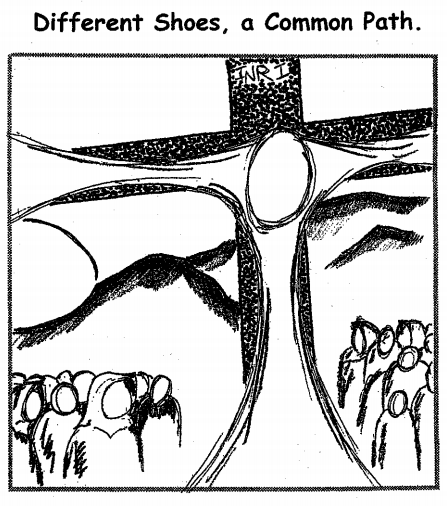
It is often said that you never truly understand a man until you walk a mile in his shoes. This is probably true, but it undervalues empathy and compassion; and it undervalues the gifts of God. God knows us better than we know ourselves, and creates understanding in our hearts for our brethren. My shoes are ones I would not wish on anybody; but even though we walk in different shoes, we walk a common path before God.
The walk with our Lord is a daily walk and a constant cycle of rebirth. It is a process of getting up every day and beginning again to walk the path that is put before us. It is a daily discipline of struggles and reassurances, of doubts and faith. It is a walk that grows easier with practice, but it never grows easy. During the days of Lent, I want to walk this path with you, and I am privileged to be invited into your walk.
Lent is the period of preparation. From the first time when the earliest Christians observed Lent, it was the time when the community brought in new brothers and sisters, taught them the ways of the Lord, and prepared for the Easter celebration. During Lent the new believers would spend the time studying and praying and on Easter morning they would experience their own resurrection just as Christ did. They would be baptized and share the communion for the first time.
Easter is what it is all about. As C.S. Lewis once said, “Without the resurrection, all that we do is in vain.” The resurrection of our Lord on Easter morning is the confirmation both of Christ’s divinity, and the triumph over death. It is a powerful declaration of God’s love and sovereign power over all of creation. Ours is an Easter faith, the faith in the redemption made possible by the resurrection.
I have chosen to write my devotionals during the period of Lent, because it is in the period of lent that I live. Lent is the preparation, the period of repentance, the period of learning. We begin lent on our knees marked by ashes. We bind ourselves with the marks of mourning, and make ourselves very mindful of our sinful and fallen ways. We observe lent through various ways of fasting and serving. We fast to set right our bodies and our urges, and we offer our service in grateful response to the grace given to us. Ultimately, in the Easter feast, we celebrate our own rebirth just as we remember our Lord’s.
The lives of prisoners are nothing other than parables of Lent. I was brought to my knees in mourning and repentance before the Lord. And just as my life is barren of the pleasures of life, it is nothing other than a type of fasting. This is a period of building up, a period of learning, and a period of service. The rebirth of these past many years is of God and is from the depths of my own soul and life. Years from now the day will come when I will walk free from this place and experience another kind of rebirth. My time here in prison is my own Lent, an in-between period of growth and repentance.
Lent is the hard part. We are born anew in Christ when we first come to repentance and cast our cares upon the Lord. We place our faith in the Lord, and we start down a new path. It is a walk that ends in Heaven, but one that is often difficult to walk. Lent is the humble and dark period, the dark night of our soul; and yet it is in the darkness that the light shines the brightest. We must learn from the Lord, and from the bible, and we must have the courage to follow the way The Lord leads. This is, for all of us, a daily struggle and a daily journey. We will fail at these tasks, and, as the Benedictine monks teach: “each day we must begin again.”
This is the hard part: to walk each day upon the path The Lord is leading us upon.
This is written for prisoners and free people alike. So your path may be very much like mine, or very different. But ours is a common path of discovery: a path of repentance, sanctification, and the uplifting and life sustaining power of God’s love. And if we walk in different shoes, that does not lessen our empathy or our compassion. We are simple brothers and sister, on a common journey.
I encourage you to approach Lent with reverence, and to observe it with fasting of some way. Maybe you need to fast from some type of food, from some type of addiction, from some pleasure, or some indulgence. The important issue is that you take some step to ensure that your walk is more as God intended it to be, and that you free yourself from any hold or addiction that the world might have on you. It is not that there is any great evil in any pleasure, for they too are gifts from God; but it is we who must be the master of our urges, and not our bodies. Periodically abstaining from things can, of occasion, help us to keep our lives in proper perspective. And if we choose to end our fast at Easter, then we will discover a new pleasure as we rediscover these gifts. So if your fasting is from chocolate or meat, cigarettes or sex, from television or books, I encourage you to observe Lent in this way.
But to follow in the ways of God is not just to put down, it is also to pick up. I encourage you to observe Lent by taking upon yourself the things that are of God. Maybe it is the daily study and devotion that we will do together, maybe it is the study of some other Christian learning (I recommend C. S. Lewis, Madeline L’Engle, Alister McGrath, Donald Miller, or Lauren Winner.) maybe it is some godly service that you are being called to do, maybe it is just that you need to learn to be kinder in your words and actions towards others. Whatever it may be, there are surely ways that you can allow God to build you up in your Christian life. I encourage you to take upon yourself some new discipline in your walk with Christ.
Lent is a time of spiritual journey, but part of that is about these practical steps. Our spiritual journey must be made manifest in our lives in some way. Ours is not just beliefs, it is also acts. We must live in the gratitude that Grace has given birth to in our lives. And it serves little purpose to be built up in the ways of God, if you do not do something with it. What point is it to learn if not to teach; why pray if not to intercede; why grow if not to mentor?
So I offer up to you what little wisdom and experience God has given me. I hope we can walk our journey together, and I hope my life can offer you insight into your own.
What follows are 48 devotionals: one for each day of Lent from Ash Wednesday until Easter, including the Easter Vigil. All scripture references are taken from the New Revised Standard Version of the Bible, but any good translation will suffice. I encourage you to read the Daily office readings, read the devotional, and then spend a few quiet moments in prayer meditating on what God is speaking to you on this day. At the end of each devotion are some words of prayer from the Book of Common Prayer (1979).
January 31, 2016
Jeremiah 1:4–10
Psalm 71:1 –6
1 Corinthians 13:1 –13
Luke 4:21 –30
Fear, Love, Wombs. today’s readings offer us a great deal to wrestle with.
God’s call is a scary thing. Scripture repeatedly shows God calling upon otherwise ordinary people to do extraordinary things through His power. Fear seems a logical response. Fear, the ever-present human emotion. Fear of not being good enough, of not measuring up. Fear of moving out of your comfort zone, into the unknown. Fear of being rejected, of being found wanting. Fear of bodily harm.
God speaks to us in our fear: “Do not be afraid.”
Why not? Why shouldn’t we fear? All our fears are entirely predictable, entirely reasonable.
“Do not be afraid” says the Lord, “For I am with you.”
WITH me? With ME? You don’t know me.
“I have known you,” Says the Lord, “since before you were in your mother’s womb.”
The words that are calling and anointing Jeremiah are unexpected. Jeremiah is a young man on the path to the priesthood when God interrupted his life. God challenged him, anointed him, and called him out of his comfort zone to serve as God’s Prophet. The rest of Jeremiah’s writings show us how powerfully God used him. His words convey the deep love God has for His people, as they are carried away into captivity. Jeremiah’s tears convey the depth of his own love for God and for God’s people.
God has known each of us since before we were formed in our mother’s womb. It is a shocking statement, a declaration to God’s omniscience. Many of us fear being that well known, that intimately watched over. We fear that if we are so well known, we will no longer be loved. We don’t want others to know our weaknesses and sins.
The psalmist, crying out for deliverance, again speaks to our fear, reminding us “I have relied upon you from my mother’s womb.”
God doesn’t just know us, God gives us life, sustains us each and every day, and gives us the love that makes life worth living. From the moment of conception we are dependent upon God for all that we are. As Christians we seek to always remember and honor that. As the psalmist finds himself beset by fear and in need of deliverance, he is comforted by the reminder of God’s omniscience and providence.
We can trust God’s knowledge of our lives because it isn’t voyeurism. God is neither “Big Brother” nor a ‘peeping tom.’ God knows us so intimately simply because God loves us. The love of God is reflected in the eyes of young lovers on their honeymoon and old lovers celebrating 60 years of marriage. It is in the face of a mother seeing her baby for the first time, and in the look of agony upon her face as she watches her son hang from the cross. It is in the eyes of Christ, on that cross, looking down upon the woman who is both His mother and His child.
A mother’s love is a special reflection of the divine love. Yesterday I had a visit with my mothers. One woman, who gave birth to me, raised me, and has never stopped loving me; and the other, who with her husband and children has chosen to love me as if she had. It was a visit full of love and laughter.
Looking around the prison visiting room, crowded on a New Year’s holiday, I was struck by how many mothers and sons I saw. These women know us. They changed our diapers, nursed us, and still stood beside us in court. When others abandon us, they visit. When the world chooses to forget us, they hold our memory precious. It is a love that was born in the womb, yet one that transcends it. As Paul reminds us, it is that love that gives value to this life and endures into the next.
Yet not every story is a good one, and so God’s work must continue. Mother’s deliver babies alone and afraid; too often mother’s die. Children are born sick, addicted, and are too often abused. There is work yet to be done.
God is calling us out. Go forth and proclaim the gospel. Do the work of loving service. Transform the world.
Fear not.
Yes, God really does want us, for God knows us and loves us from before the womb. God is with us and, when all else passes away, that love endures.
January 24th, 2106
Nehemiah 8:1 –3, 5–6, 8–10
Psalm 19
1 Corinthians 12:12–31a
Luke 4:14–21
What does it mean to be The Body of Christ? What does it mean to love one another and still welcome into our midst the stranger? When Jesus announces Himself amongst us, will we be able to receive Him?
One beautiful gift of a prison church is its diversity. Prison is full of men of every age, race, and background. Some have grown up here, some have grown old. we have doctors, the mentally disabled, and everyone in-between. Our church has the most diverse congregation I have ever heard of.
But our diversity isn’t a magic cure-all for sin. Into this community each individual brings their own gifts, and the baggage of their own sin. We judge, we gossip, and struggle. We are a holy work-in-progress. As much as we learn from one another, and as deeply as we love, we also wound.
I am blessed to be a part of another congregation, at Saint David’s Episcopal. They befriended and welcomed me, even though it hasn’t always been easy.
Several years ago Saint David’s, as a congregation, identified and named the core values of their community. Among those values was “inclusion.” That is a good Christian value, one comfortable to proclaim but often uncomfortable to live. When questions about my joining the community were raised, they challenged them to live out this value. They choose to include me. I believe it has enriched all of us.
Diversity and inclusion are hallmarks of a Christian community, but they can be a challenge we struggle with. In his first letter to the church at Corinth Paul taught about the struggle. Chastising jealousy and envy Paul reminded them, and us, that our unity is as The Body of Christ, and it is a unity that requires and honors a diversity of individual identities and gifts.
Finding community with someone different from ourselves takes work. honoring each others’ gifts demands humility. Living in a prison cell with another person demands accommodation. Often I have worked to find a cell-mate similar to me, but over the years I have also had many cell-mates far different. When I was young, some were old; I am white, some have been black; I am a Christian, some have been Muslim; and as I grow older, some are now young. To find our common identity demands that we see with more than our eyes and hear with more than our ears. It demands the faith to look and listen to one another with our hearts.
Honoring Christian community in the face of disagreements on challenging social issues can be even more difficult. Recently an international prison ministry to which I have devoted 16 years of love, prayers, and service faced this very question. Challenged with how to move forward and honor our diversity, they retreated. Struggling to be The Body of Christ, they chose amputation.
Doing so they rejected not only me, but my entire faith community and denomination. They did this because we chose to stand beside and honor the work of God in and through a member of our community who is a married lesbian.
Amputation. After 15 years of war in the Middle East we don’t have to look very far to see wounded bodies. Heroes like my step-brother are the wounded warriors in our midst and show us the challenges. What if The Body of Christ looked like that? How would we walk with no legs, hug with no arms, or love with only half a heart? Who would we be?
Luke’s Gospel shows us Jesus returning to the place he grew up, ready to begin His incarnate ministry. With the words of Isaiah He proclaims God’s work. The results are…. underwhelming. The community chooses to retreat into familiarity, and it blinds them to Christ’s identity and mission.
Familiarity can be a gift, but it can blind us to the presence of God. We cannot always retreat to what is comfortable. Our diversity is what keeps us open to the new works God is doing. Only when familiarity and diversity balance and challenge one another can our communities flourish. Together we grow, together we hear God. We must be ecumenical; we must be inter-denominational. We must honor and welcome the unique gifts we bring. We must welcome the stranger in our midst. We can’t just say we are The Body of Christ. We have to live it.
 Prison Lectionary