Tuesday, Second Week in Lent

By Matthew B. Harper

Psalm 62:1-2 – For God alone my soul in silence waits; from him comes my salvation.

Paul talks of the purity of the church, and Jesus tells us about the unity of it. Our strength comes when we stand united in faith, brothers in the family of God.

When I first came to prison I was terrified. Being a ‘new fish’ in a major penitentiary is an uncomfortable experience. God has given me a gift in my size and strength, but this is prison, and those things do not always matter.

I have been very careful, and very prayerful about how I have lived. I spend a lot of time working out, and I have found everywhere I have been that most of the biggest men on the weight pile were men of faith. My cellmate and I are the leaders in the Kairos ministry and dedicated weight lifters; the outside Kairos leader also calls us ‘his bouncers.’ I was worried about prison gangs and violence, and I have found the strength instead in the Christian fellowship and community.

We have our faith issues on the inside just as the church on the outside does but whatever little issues seem to challenge us we have to stand united on the deeper faith that unites us. Today’s scriptures remind us that when we live right, and live united in faith, then we can withstand the ways of the Satan. There are many things in this world, both mine and yours, to distract us from the family of the church, but my soul waits for God.

In all our tribulation; in all time of our prosperity; in the hour of death, and in the day of judgment, Good Lord, deliver us” BCP 149

Monday, Second Week in Lent

by Matthew B. Harper

Psalm 56:2 – My enemies trample on me all day long, for many fight against me…

Today in the daily office we read more of the story of Joseph, who was betrayed by his brothers. Psalm 56, also read today, echoes the cry of betrayal and abandonment. And yet we also read Paul, commending himself to the Corinthians as their ‘father through the Gospel.’

Like many men who have come to prison for their crimes, I have been written off and abandoned by almost all of my family, most of my friends, and I lost one whom I loved so very dearly. There are not words for the pain and loneliness that this leads to, or the desperation that I sometimes feel. But the stories of Joseph and Abraham do not end with their pain, and neither does mine.

While it is important to try to understand the amazing pain and anger of Joseph, we are seeing how God used him to save so many Egyptians, his family, and ultimately the nation of Israel. We can identify with Joseph’s anger and fear, but we must also identify with the blessings that came through what he endured. I have many friends that I am closer to now than I ever could have been before, I have better and more honest relationships with the family still in my life, and I have many new and dear friends – on the inside and out.

The world takes, but God gives and restores. Praise be to God.

By thine Agony and Bloody Sweat; by thy Cross and Passion; by thy precious Death and Burial; by thy Glorious Resurrection and Ascension; and by the Coming of the Holy Ghost, Good Lord, deliver us” BCP 149

Wednesday, First Week in Lent

by Matthew B. Harper

Psalm 119:67 – Before I was humbled I went astray, but now I keep your word

There is something powerful in being humbled before God and man. Most of us come to the faith full of arrogance. We think ‘wow, God is really lucky that He’s got me on His side’. And we look at churches thinking only of what they can do for us. And when we are in our pride, we go astray from God. We do not trust the Spirit, and we argue away the scriptures. We put ourselves above our own consciousness, and above God. And then we are humbled. God may humble us, or the world will humble us if God does not get to it first.

One common thing about every major prophet and servant of God, throughout the whole bible, is that they were all first humbled before God and man. Some, like Moses David and Paul, were murderers; some, like Peter, denied Christ before man; and some, like the leper in today’s Gospel, suffered from a horrible disease. As humans we are too much in our pride, and we cannot approach God in this way. We must be humbled before we can truly come to God with an honest heart. It is only when we are humbled, when our pride is replaced with repentance, that we can experience the redemptive power of God. The former warden of the prison I am now at once said: “A man must know he is lost, before he can be saved.” And then we, like the leper, can be healed.

And when that happens we can, like the leper, run forth and proclaim God to all who would hear.

From all false doctrine, heresy, and schism; from hardness of heart, and contempt of thy word and commandment, Good Lord deliver us.” BCP 149

Epiphany C4

by Matthew B. Harper

January 31, 2016

Jeremiah 1:4–10
Psalm 71:1 –6
1 Corinthians 13:1 –13
Luke 4:21 –30

Fear, Love, Wombs. today’s readings offer us a great deal to wrestle with.

God’s call is a scary thing. Scripture repeatedly shows God calling upon otherwise ordinary people to do extraordinary things through His power. Fear seems a logical response. Fear, the ever-present human emotion. Fear of not being good enough, of not measuring up. Fear of moving out of your comfort zone, into the unknown. Fear of being rejected, of being found wanting. Fear of bodily harm.

God speaks to us in our fear: “Do not be afraid.”

Why not? Why shouldn’t we fear? All our fears are entirely predictable, entirely reasonable.

“Do not be afraid” says the Lord, “For I am with you.”

WITH me? With ME? You don’t know me.

“I have known you,” Says the Lord, “since before you were in your mother’s womb.”

The words that are calling and anointing Jeremiah are unexpected. Jeremiah is a young man on the path to the priesthood when God interrupted his life. God challenged him, anointed him, and called him out of his comfort zone to serve as God’s Prophet. The rest of Jeremiah’s writings show us how powerfully God used him. His words convey the deep love God has for His people, as they are carried away into captivity. Jeremiah’s tears convey the depth of his own love for God and for God’s people.

God has known each of us since before we were formed in our mother’s womb. It is a shocking statement, a declaration to God’s omniscience. Many of us fear being that well known, that intimately watched over. We fear that if we are so well known, we will no longer be loved. We don’t want others to know our weaknesses and sins.

The psalmist, crying out for deliverance, again speaks to our fear, reminding us “I have relied upon you from my mother’s womb.”

God doesn’t just know us, God gives us life, sustains us each and every day, and gives us the love that makes life worth living. From the moment of conception we are dependent upon God for all that we are. As Christians we seek to always remember and honor that. As the psalmist finds himself beset by fear and in need of deliverance, he is comforted by the reminder of God’s omniscience and providence.

We can trust God’s knowledge of our lives because it isn’t voyeurism. God is neither “Big Brother” nor a ‘peeping tom.’ God knows us so intimately simply because God loves us. The love of God is reflected in the eyes of young lovers on their honeymoon and old lovers celebrating 60 years of marriage. It is in the face of a mother seeing her baby for the first time, and in the look of agony upon her face as she watches her son hang from the cross. It is in the eyes of Christ, on that cross, looking down upon the woman who is both His mother and His child.

A mother’s love is a special reflection of the divine love. Yesterday I had a visit with my mothers. One woman, who gave birth to me, raised me, and has never stopped loving me; and the other, who with her husband and children has chosen to love me as if she had. It was a visit full of love and laughter.

Looking around the prison visiting room, crowded on a New Year’s holiday, I was struck by how many mothers and sons I saw. These women know us. They changed our diapers, nursed us, and still stood beside us in court. When others abandon us, they visit. When the world chooses to forget us, they hold our memory precious. It is a love that was born in the womb, yet one that transcends it. As Paul reminds us, it is that love that gives value to this life and endures into the next.

Yet not every story is a good one, and so God’s work must continue. Mother’s deliver babies alone and afraid; too often mother’s die. Children are born sick, addicted, and are too often abused. There is work yet to be done.

God is calling us out. Go forth and proclaim the gospel. Do the work of loving service. Transform the world.

Fear not.

Yes, God really does want us, for God knows us and loves us from before the womb. God is with us and, when all else passes away, that love endures.
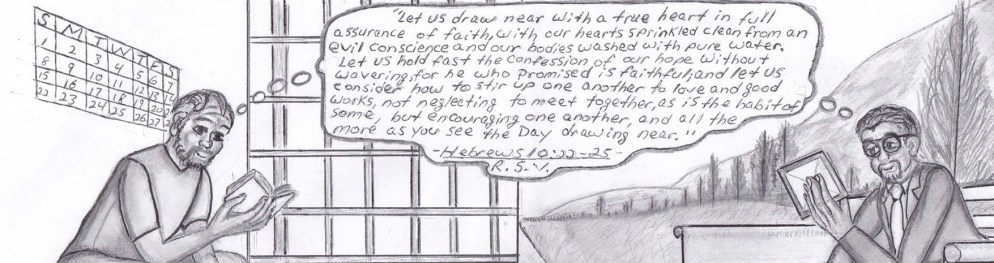
Epiphany 3C

by Matthew Harper

January 24th, 2106

Nehemiah 8:1 –3, 5–6, 8–10
Psalm 19
1 Corinthians 12:12–31a
Luke 4:14–21

What does it mean to be The Body of Christ? What does it mean to love one another and still welcome into our midst the stranger? When Jesus announces Himself amongst us, will we be able to receive Him?

One beautiful gift of a prison church is its diversity. Prison is full of men of every age, race, and background. Some have grown up here, some have grown old. we have doctors, the mentally disabled, and everyone in-between. Our church has the most diverse congregation I have ever heard of.

But our diversity isn’t a magic cure-all for sin. Into this community each individual brings their own gifts, and the baggage of their own sin. We judge, we gossip, and struggle. We are a holy work-in-progress. As much as we learn from one another, and as deeply as we love, we also wound.

I am blessed to be a part of another congregation, at Saint David’s Episcopal. They befriended and welcomed me, even though it hasn’t always been easy.

Several years ago Saint David’s, as a congregation, identified and named the core values of their community. Among those values was “inclusion.” That is a good Christian value, one comfortable to proclaim but often uncomfortable to live. When questions about my joining the community were raised, they challenged them to live out this value. They choose to include me. I believe it has enriched all of us.

Diversity and inclusion are hallmarks of a Christian community, but they can be a challenge we struggle with. In his first letter to the church at Corinth Paul taught about the struggle. Chastising jealousy and envy Paul reminded them, and us, that our unity is as The Body of Christ, and it is a unity that requires and honors a diversity of individual identities and gifts.

Finding community with someone different from ourselves takes work. honoring each others’ gifts demands humility. Living in a prison cell with another person demands accommodation. Often I have worked to find a cell-mate similar to me, but over the years I have also had many cell-mates far different. When I was young, some were old; I am white, some have been black; I am a Christian, some have been Muslim; and as I grow older, some are now young. To find our common identity demands that we see with more than our eyes and hear with more than our ears. It demands the faith to look and listen to one another with our hearts.

Honoring Christian community in the face of disagreements on challenging social issues can be even more difficult. Recently an international prison ministry to which I have devoted 16 years of love, prayers, and service faced this very question. Challenged with how to move forward and honor our diversity, they retreated. Struggling to be The Body of Christ, they chose amputation.

Doing so they rejected not only me, but my entire faith community and denomination. They did this because we chose to stand beside and honor the work of God in and through a member of our community who is a married lesbian.

Amputation. After 15 years of war in the Middle East we don’t have to look very far to see wounded bodies. Heroes like my step-brother are the wounded warriors in our midst and show us the challenges. What if The Body of Christ looked like that? How would we walk with no legs, hug with no arms, or love with only half a heart? Who would we be?

Luke’s Gospel shows us Jesus returning to the place he grew up, ready to begin His incarnate ministry. With the words of Isaiah He proclaims God’s work. The results are…. underwhelming. The community chooses to retreat into familiarity, and it blinds them to Christ’s identity and mission.

Familiarity can be a gift, but it can blind us to the presence of God. We cannot always retreat to what is comfortable. Our diversity is what keeps us open to the new works God is doing. Only when familiarity and diversity balance and challenge one another can our communities flourish. Together we grow, together we hear God. We must be ecumenical; we must be inter-denominational. We must honor and welcome the unique gifts we bring. We must welcome the stranger in our midst. We can’t just say we are The Body of Christ. We have to live it.

Epiphany 2C

by Matthew Harper

January 17th, 2016

Isaiah 62:1 –5
Psalm 36:5–10
1 Corinthians 12:1 –11
John 2:1 –11

Today is all about weddings. From the wedding poem in Isaiah to Mary’s plea during the wedding at Cana, Marriage is on our mind.

Throughout Scripture God uses the imagery of weddings to describe our relationship. Weddings speak to us of commitment, love, unity, and procreation. Despite how our earthly marriages fall short we are continually struggling to find the pure ideal that reflects God’s plan.

Isaiah’s poem is striking because of the deep longing it reveals on the part of the groom. Scriptural illustrations make it clear that we are the bride, and here we see God, the groom, who is yearning, working, and reworking us so that we might be vindicated, found worthy, and crowned.

Weddings are a big deal. In biblical times the wedding celebration was a sign of love and commitment, but also of family honor and the value and honor due the bride. We need to be vindicated because on our own we are far from worthy.

It is this family honor that is at stake for Mary. John’s gospel shows us Jesus and Mary at the wedding of a family or close community member. The size and quality of the party mattered, and demonstrated value and esteem. To run out of wine during such an occasion would have been a point of deep dishonor to the family and a devaluing of the bride.

Mary is focused on this honor, but Christ’s vision is larger. Christ has before Him the full vision of His life and ministry, and yet He is not deaf to His mother’s plea. Are His words a rebuke to her? Yes, in part, to create distance. Christ acts, but at His own choosing and not simply at His mother’s behest.

God’s gifts are always given by God’s own initiative, for God’s glory. We benefit, and we rejoice, but always to God’s greater purpose. All of today’s readings hold that as a central theme. When we have nothing left but loss, when all that we have and are has run out and we are left with the empty water of ritual, the sweet wine of the Gospel refreshes us and leaves us drunk on joy.

The patriarchy and honor-rituals of biblical weddings are foreign things we have mostly grown out of. They are best left in the past. But we can see in the imagery a powerful analogy of our relationship with God, and a vindication of our identity.

The movement from loss and ritual to joy is the testimony of every believer. It is not only the prisoner who knows destitution and rejection, it is not only we who need to be set right. All of God’s creation needs the gifts only God can provide.

God’s gifts are not charity. Each of the destitute has, at one time or another, received charity. It can feed your body, but not your soul. The yearning we hear in God’s wedding poem isn’t simple philanthropy. It’s Love. Our promise of Hephzibah, of Beulah, is a promise of Love, of Marriage, of a God who loves and delights in us.

Philanthropy, like the Canaanite Cults of Isaiah’s day, offer visions of fertility, but marriage is more than that. What God yearns for, and offers, is a fertile marriage of love and delight.

This celebration transforms us. The words of Isaiah promise a remaking, a vindication, and Paul’s letter to the Corinthians discusses the many gifts God gives and how they work together for our benefit and God’s glory. We will be a bride crowned with a royal diadem, a highest honor given not because of who we were but because of who God is and what God has made us.

Every bride is beautiful. The love of the groom has the power to transform her in the eyes of all present. It has never been that beautiful people are loved, but rather that love itself makes us beautiful. When we acknowledge and live in the overwhelming Love God has for us, we will be transformed.

You are loved and you are beautiful
You are married to God
Let the wine flow.

Let the party begin.

12th Day of Christmas

by Matthew B. Harper

For you, O LORD, are most high over all the earth; you are exalted far above all gods. (Psalms 97:9)

How often do we really put God first? How often are we willing to do the difficult things that the Bible speaks of? How often are we willing to be loving, and not just always ‘right?’ How often are we willing to put forth our hand in love towards those that seem the most unlovable? What has our encounter with God done to us?

During Christmas we recall the humble shepherds who came to Christ’s infant bed; and I often wonder what happened to them afterwards. The gospels only record that the shepherds left the infant Jesus to go forth praising what they had seen. To truly encounter Christ changes us. Whether we accept or reject the offer of mercy and grace, our encounter with the risen Lord will have an impact on our lives, in each and every area.

In prison there is always someone watching. There are always people wanting to see if the changes are real, and if they are lasting. Because some people leave prison, and soon return bringing with them new crimes, new time, and new victims. But there are other men, ones for whom everything becomes different in a wonderful way. These men are able to go forth, in prison or out of it, into a transformed life. They are healed, and in their new life they can often become healers. This can only be by the power of God.

With God there is no addiction that cannot be overcome, and there is no idol that cannot be torn down. The God most high overcomes all. When we put God first in our lives then all things are made new, and the difficult is not so difficult. We are filled with God’s love and it spills over into loving others.

The snow lay on the ground, the stars shown bright, when Christ our Lord was born on Christmas night. Venite Adoremus Dominum. Venite Adoremus Dominum. (Hymn 110)

Epiphany 1C/The Baptism of Christ C

by Matthew Harper

January 10th, 2016

Isaiah 43:1 –7
Psalm 29
Acts 8:14–17
Luke 3:15–17, 21 –22

Christ’s baptism is a defining moment in the redemption story. This event is a significant declaration to the world about who He is, and the beginning of Christ’s incarnate ministry. The baptism says a lot about Jesus, but perhaps it says even more about God, and about us.

Isaiah, in one of my favorite passages that we read today, shows us the radical initiative of God’s love. God, the creator and sustainer of the heavens and earth, is declaring a deeply personal love for each of us. God has “called us by name,” (v.1) we are “precious and honored,” (v.4) and we will be ‘ransomed’ (v.4-6). God’s redeeming love is a revelation.

But how will God ransom us? And from whom or what will be be ransomed? And, perhaps most importantly, why?

Luke shows us the beginning of the fulfillment of these promises. We are so loved that God’s only begotten Son, God incarnate, has come to ransom us. Jesus comes with both power and judgment. He has the power to see us as we are; He has the authority to judge; and He has the power to set things right.

In introducing us to the person and mission of Jesus Luke has recorded the words of John the Baptizer. John shows us a truth about ourselves, something we already know but never want to face. The power we are enslaved to, and need ransoming from, is, quite simply, us.

Christ offers us acceptance and forgiveness, but will demand repentance. We are imprisoned by our own sin, and the only way out is through repentance and faith in Christ; only through Him can things be set right.

Which brings us to the most important question for our purposes today: why? The baptism of Jesus is the beginning of His incarnate ministry, the anointing by God into Jesus’ earthly work. The same is true for us. Linked to Christ through faith, adopted into the very Body of Christ, our baptism was not only part of our rebirth it is also the beginning of our ministry.

Knowing we are enslaved by sin isn’t new knowledge to anyone in prison, but facing it is difficult. Bad things and bad people have happened to too many of us, and it is easy to point fingers; but the ultimate blame must always lie with us. It is our enslavement to pride, lust, anger and addiction—our own sin—that has left us destitute and distant from God. Only Christ can ransom us and set us free.

But why would He? Why would Christ bother with one such as me?

Love.

The words of God through Isaiah are a revelation. They are a life-giving breath of fresh air, a light in the darkness. The simple truth is that God loves us that much, not because of who we are, but because of who God is. We belong to God.

God does not ransom us only for our salvation, but also for our sending. Redemption isn’t the last word, there is also mission. What we have received we must share, what has been accomplished must be celebrated and proclaimed.

Being sent is scary. It will take us way outside of our comfort zone, and force us to question ourselves and our purpose. It will mean loving others, even those who are hard to love. We will have to talk, teach, and share our testimony. It will mean caring, and making ourselves vulnerable. But we begin our mission with those other powerful words from today’s reading in Isaiah: “fear not… for I am with you,” (v.1-2).

We are loved,
We are ransomed,
And we have work to do.

10th Day of Christmas

by Matthew B. Harper

The LORD is my shepherd… (Psalm 23:1)

It is comforting to remember Christ the Good Shepherd; but have you ever stopped to think what it means to be his sheep? Sheep are disobedient, and unruly animals. Sheep are smelly and dirty, and they are not the cute animals that they appear to be. Sheep are often very human. But it is these creatures that need a shepherd. If sheep were clean and well disciplined, then they would not need a shepherd to look out for them and guide them. Humans are like sheep, and we need a shepherd.

The danger comes often when we are so eager to follow, that we will follow anybody. When people feel marginalized, depressed, and afraid they will grasp at any straw, they will follow any shepherd. In prison, when men are at their lowest, I have seen them embrace anything and everything. We have groups in prison that try to cling all kinds of sects, schisms, cults, and other faiths. It is not always enough to know you are lost. But Christ is real, Christ that has the power to come to us and search us out.

We come to know Christ most truly, and most deeply, when we are lost. We learn about God’s Love when we allow God to love us when we feel unlovable. I wish there was an easier way to learn to trust God, but for many of us it had to be a rocky road to redemption. We all, like sheep, have gone astray. But it is Christ who has sought us out and brought us home.

I have never been so far from everything I love. When the world is difficult for us, God uses those times to love us more intensely, and to sustain and protect us.

It came upon a midnight clear, that glorious song of old, from angels bending near the earth to touch their harps of gold; “Peace on earth, good will to men, from heaven’s all gracious King.” (Hymn 89)

2nd Sunday of Christmas/Epiphany Sunday

by CM

Psalm 72:1-7, 10-14

Our Savior entered the world as a solution to a problem that a significant portion of the people in power didn’t even realize existed. Those who has the scriptures, those in positions in the government, those with the resources and the means to solve the problem never deployed them because they were blind to it.

Here comes Jesus, born King yet He carried a mandate from on high to bring a solution to a problem that was so prevalent that the powers that be sought to slay Him even as a baby. Why? Because His life was meant to expose those in authority, those in power, as the source of the problem.

Our reading identifies a number of issues: lack of justice and disenfranchisement of the poor, oppression, hopelessness, cruelty. These conditions are all results of sin. However, they lack the abstract notions of what constitutes one’s individual nature and squarely categorize the issues involved in the way the powerful treat the common man. It was the state that took issue with the life of Jesus, the religious folk who pledged loyalty to the state, “We have no king but Caesar.” Why? Because they couldn’t see THEMSELVES as the problem.

Being that those same problems still exist and persist, what are we not seeing today in relation to their presence? Jesus exposed the systematic injustice, unrighteousness, corruption, cruelty and evil in the simplicity of the fact that they killed him! Sometimes people have a tendency to gloss over that fact.

What does it say—right where the rubber meets the road—about ANYONE, ANY SYSTEM, that kills a person? Let that word sink in for a moment. A PERSON such as Jesus. Not, “Son of God,” not “The Christ.” We have to ask the question, was Mary’s baby boy a bad PERSON? Because make no mistake about it, in a very NON-ABSTRACT way, that is who they—the powerful, the ruling class, the government—killed. And unless he was at the very least a bad person, they killed him wrongfully.

Are we “divorced” from seeing the same today? Have we forgotten that Jesus said something about how the way we treat “the least of these” equals how we treat Jesus? If we take issue with seeing Jesus as simply being a Person, it may indicate a lack of the ability to see the downtrodden as Jesus.