Lectionary: Proper 8C / Ordinary 13C / Pentecost +6

Luke 9:51-62

“The Manner of the Spirit”

by AMN

In this passage, Jesus is on his way back to the Holy City and he stops by a Samaritan village on his way there. The Samaritan villagers give him unwelcoming gestures to leave their village because they know where he is headed. For those of you who don’t know the times, Jews and Samaritans had a very strong dislike towards each other. The Jews thought them to be lesser than them because the Samaritans’ fellowship with God got watered down over the centuries.

Continue reading

Poem: “Life”

by Vickie Rose Byrd

Luke 23:34

“Life”

(to accompany the drawing “Life”)

Falsely accused, used, and abused, beaten
torn apart. The question screams within
my heart. Why must i live in fear, is
this the vision of my life, not clear, in my
eyes all you’ll see is sadness, surrounded
by all this madness. not so long ago, i was
left for dead, my tears dripped of blood so
red. they could fill a river, i start to shiver.
Sorrow and moaning was all one could
hear, is some one near. i closed my swollen
eye, that is black as night. prayed to the
lord, “forgive them father. they don’t know wrong
from right. My Life to you i give, for you, i want
to live.” i hear a voice say “you have done your best.
it’s time to rest, your sins are forgiven. close
that door. i wait to give you so much more.
if you stumble or fall, call on the name of
Jesus Christ. i will hear your call. so
rise up. stand tall.”

Continue reading

Lectionary: Pentecost C

by Matthew B. Harper

PENTECOST, May 15, Acts 2

Pentecost is marked in the church with celebration and fire. Our clergy dress in red and our hangings use images of fire and wind. Pentecost is drama.

But to the observers of the first Christian Pentecost what was transpiring looked more like drunken excess. Was there ever a miracle of God so poorly misunderstood? Were there ever prophets more unlikely?

Continue reading

POEM: “for whom?”

by Taj Alexander Mahon-Haft

in dialogue with Luke 6:34-37 and Luke 17:3-4

Taj 3how can
this land of
uniquely mandatory minimums,
third strikes
called by referees blind to circumstance,
perfidious
truth in sentencing,
threats by bully prosecutors,
most of all
no take backs
one time only sales
American exceptionalism
exceptionally American
uncruel and usual
death sentences
call itself
land of second chances?

Good Friday

by Matthew B. Harper

Luke 23:34 – Then Jesus said: “Father, forgive them; for they know not what they are doing.”

Last night was a bad night. Sometimes I have a bad night, or bad hours here and there. Nightmares, bad thoughts, and generally spending my time mentally trapped in those horrible few hours when I did the horrible things that brought me to prison.

It was almost midnight, but on weekends we aren’t locked down till 1 AM. So I took a chance on my mom the night owl, and I got up and called home. Mom accepted the call, listened to me and told me she loved me. Then she turned to lighter things to talk about, and even made me laugh a little. I was able to sleep. The support and forgiveness from both of my parents is amazing and humbling.

Forgiveness? Those same parents are the parents of the person I killed. Anne Elizabeth wasn’t just my sister, she was their only daughter. They are the most direct living victims of the horrible things I have done. Their love for me is greater than their anger; and they have forgiven me.

I once asked my mother how she could possible forgive me and she replied: “I can’t. It is beyond me. It is of God.” The forgiveness from my parents is the greatest and most transforming gift I have ever received.

And as Jesus was being tortured and executed he begged his father to forgive his murderers. And God did.

Praise Be To God.

Almighty God, we beseech thee graciously to behold this thy family, for which our Lord Jesus Christ was contented to be betrayed, and given up into the hands of sinners, and to suffer death upon the cross; who now liveth and reigneth with thee and thy Holy Ghost, ever one God, world without end. Amen. BCP 169

Maundy Thursday

by Matthew B. Harper

Luke 22:26 – The greatest among you must become like the youngest, and the leader like one who serves.

It has been said that humility is the one virtue that once you think you have it, you don’t.

All of us suffer from a preoccupation with ourselves; we are prone to arrogance, to pride, to ego-centrism. And in our arrogance we lessen the very humanity of other people. What few of us stop to think about is that if we are first, it means we are forcing others to be last.

And you cannot conquer arrogance your pride by fighting it head on. The first reaction to such an endeavor is to always say “man, I’m beating this pride!” and there you go, taking pride in not being proud!

The path of Jesus was never to pretend to be less than he was, it was to show us that with the power of God we are more than we believe we are. The way to suppress pride is to elevate other people. When we approach other people as children of God, when we open our hearts to love them, when we see Christ in the eyes of every person we meet, then there will be no pride within us, no arrogance.

That is the Christ heart.

Almighty Father, whose dear Son, on the night before he suffered, did institute the Sacrament of His Body and Blood: Mercifully grant that we may thankfully receive the same in remembrance of Him who in these holy mysteries giveth us a pledge of life eternal, the same thy Son Jesus Christ our Lord; who now liveth and reigneth with thee and the Holy Spirit, ever one God, world without end. Amen, BCP 169

Lectionary: Palm Sunday

by LA

Luke 19:28-40

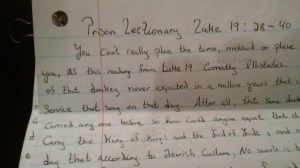
You can’t really plan the time, method or place the Lord chooses to use you, as this reading from Luke 19 correctly illustrates. I’m sure that the owners of the that donkey never expected in a million years that it would be called into service that way on that day. After all, that same donkey had never in its life carried anyone before. Lent C Palm Lk So how could anyone expect that it would be asked to carry the King of Kings and the Lord of Lords? And on the Shabbat no less! A day that according to Jewish custom no work is to be done by human or beast.

Sometimes you can be just as surprised as the owners of that donkey when the Lord calls on you. You could be in the bull pen waiting to go “up top” for a visit and feel the calling to share a word or two of the gospel with the prisoner locked in there with you. Or you could be walking in the chow line when you are called to say a kind word to the man ahead of you.

When these “callings” come don’t worry about how awkward this encounter is gonna be or that this might make you look like a lame. Instead, remember what the owners of that donkey did when they found that the reason the disciples were untying their colt was that “the Lord hath need of it.” Did they argue? Did they protest the Shabbat or make excuses? No. They obeyed and the Lord rode that donkey into Jerusalem in triumph.

Some of the Lord’s greatest triumphs are on the backs of the most unexpected callings of a believer to obey.


Fourth Sunday in Lent

by Matthew B. Harper

Luke 1:32-33 – …the Lord God will give to him the throne of his ancestor David. He will reign over the house of Jacob forever.

Jesus, the eternal Lord, sits upon the throne of David. Prisoners love the story of David. David the great king was also David the murderer and adulterer. In David’s story we see great sin, but also profound repentance and deep faith. On this the holy dynasty was founded.

Did David suffer for his sins? Of course. David lost his kingdom for a time, his family, and the son conceived in adultery died. But all of his suffering changed him, and it rooted his faith even deeper. David wasn’t strong enough to be used by God. He became weak enough.

Martin Luther King Jr. once said “the cross we bear always proceeds the cross we wear.”

We all bear our cross. We all sin. We all suffer. In well-to-do suburban churches this is not a common or easy truth, so learn it from those who know it intimately. We all sin and fall short of the glory of God. When we are able approach God with profound repentance, and are willing to remain steadfast in our faith, God will use us, and transform us. Everyone is capable of repentance, and from a position of profound repentance you can be weak enough to be used by God and raised to great heights.

Gracious Father, whose blessed Son Jesus Christ came down from heaven to be the true bread which giveth life to the world: Evermore give us this bread, that he may live in us, and we in him; who liveth and reigneth with thee and the Holy Spirit, one God, now and for ever. Amen” BCP 167

Epiphany C4

by Matthew B. Harper

January 31, 2016

Jeremiah 1:4–10
Psalm 71:1 –6
1 Corinthians 13:1 –13
Luke 4:21 –30

Fear, Love, Wombs. today’s readings offer us a great deal to wrestle with.

God’s call is a scary thing. Scripture repeatedly shows God calling upon otherwise ordinary people to do extraordinary things through His power. Fear seems a logical response. Fear, the ever-present human emotion. Fear of not being good enough, of not measuring up. Fear of moving out of your comfort zone, into the unknown. Fear of being rejected, of being found wanting. Fear of bodily harm.

God speaks to us in our fear: “Do not be afraid.”

Why not? Why shouldn’t we fear? All our fears are entirely predictable, entirely reasonable.

“Do not be afraid” says the Lord, “For I am with you.”

WITH me? With ME? You don’t know me.

“I have known you,” Says the Lord, “since before you were in your mother’s womb.”

The words that are calling and anointing Jeremiah are unexpected. Jeremiah is a young man on the path to the priesthood when God interrupted his life. God challenged him, anointed him, and called him out of his comfort zone to serve as God’s Prophet. The rest of Jeremiah’s writings show us how powerfully God used him. His words convey the deep love God has for His people, as they are carried away into captivity. Jeremiah’s tears convey the depth of his own love for God and for God’s people.

God has known each of us since before we were formed in our mother’s womb. It is a shocking statement, a declaration to God’s omniscience. Many of us fear being that well known, that intimately watched over. We fear that if we are so well known, we will no longer be loved. We don’t want others to know our weaknesses and sins.

The psalmist, crying out for deliverance, again speaks to our fear, reminding us “I have relied upon you from my mother’s womb.”

God doesn’t just know us, God gives us life, sustains us each and every day, and gives us the love that makes life worth living. From the moment of conception we are dependent upon God for all that we are. As Christians we seek to always remember and honor that. As the psalmist finds himself beset by fear and in need of deliverance, he is comforted by the reminder of God’s omniscience and providence.

We can trust God’s knowledge of our lives because it isn’t voyeurism. God is neither “Big Brother” nor a ‘peeping tom.’ God knows us so intimately simply because God loves us. The love of God is reflected in the eyes of young lovers on their honeymoon and old lovers celebrating 60 years of marriage. It is in the face of a mother seeing her baby for the first time, and in the look of agony upon her face as she watches her son hang from the cross. It is in the eyes of Christ, on that cross, looking down upon the woman who is both His mother and His child.

A mother’s love is a special reflection of the divine love. Yesterday I had a visit with my mothers. One woman, who gave birth to me, raised me, and has never stopped loving me; and the other, who with her husband and children has chosen to love me as if she had. It was a visit full of love and laughter.

Looking around the prison visiting room, crowded on a New Year’s holiday, I was struck by how many mothers and sons I saw. These women know us. They changed our diapers, nursed us, and still stood beside us in court. When others abandon us, they visit. When the world chooses to forget us, they hold our memory precious. It is a love that was born in the womb, yet one that transcends it. As Paul reminds us, it is that love that gives value to this life and endures into the next.

Yet not every story is a good one, and so God’s work must continue. Mother’s deliver babies alone and afraid; too often mother’s die. Children are born sick, addicted, and are too often abused. There is work yet to be done.

God is calling us out. Go forth and proclaim the gospel. Do the work of loving service. Transform the world.

Fear not.

Yes, God really does want us, for God knows us and loves us from before the womb. God is with us and, when all else passes away, that love endures.
Epiphany 3C

by Matthew Harper

January 24th, 2106

Nehemiah 8:1 –3, 5–6, 8–10
Psalm 19
1 Corinthians 12:12–31a
Luke 4:14–21

What does it mean to be The Body of Christ? What does it mean to love one another and still welcome into our midst the stranger? When Jesus announces Himself amongst us, will we be able to receive Him?

One beautiful gift of a prison church is its diversity. Prison is full of men of every age, race, and background. Some have grown up here, some have grown old. we have doctors, the mentally disabled, and everyone in-between. Our church has the most diverse congregation I have ever heard of.

But our diversity isn’t a magic cure-all for sin. Into this community each individual brings their own gifts, and the baggage of their own sin. We judge, we gossip, and struggle. We are a holy work-in-progress. As much as we learn from one another, and as deeply as we love, we also wound.

I am blessed to be a part of another congregation, at Saint David’s Episcopal. They befriended and welcomed me, even though it hasn’t always been easy.

Several years ago Saint David’s, as a congregation, identified and named the core values of their community. Among those values was “inclusion.” That is a good Christian value, one comfortable to proclaim but often uncomfortable to live. When questions about my joining the community were raised, they challenged them to live out this value. They choose to include me. I believe it has enriched all of us.

Diversity and inclusion are hallmarks of a Christian community, but they can be a challenge we struggle with. In his first letter to the church at Corinth Paul taught about the struggle. Chastising jealousy and envy Paul reminded them, and us, that our unity is as The Body of Christ, and it is a unity that requires and honors a diversity of individual identities and gifts.

Finding community with someone different from ourselves takes work. honoring each others’ gifts demands humility. Living in a prison cell with another person demands accommodation. Often I have worked to find a cell-mate similar to me, but over the years I have also had many cell-mates far different. When I was young, some were old; I am white, some have been black; I am a Christian, some have been Muslim; and as I grow older, some are now young. To find our common identity demands that we see with more than our eyes and hear with more than our ears. It demands the faith to look and listen to one another with our hearts.

Honoring Christian community in the face of disagreements on challenging social issues can be even more difficult. Recently an international prison ministry to which I have devoted 16 years of love, prayers, and service faced this very question. Challenged with how to move forward and honor our diversity, they retreated. Struggling to be The Body of Christ, they chose amputation.

Doing so they rejected not only me, but my entire faith community and denomination. They did this because we chose to stand beside and honor the work of God in and through a member of our community who is a married lesbian.

Amputation. After 15 years of war in the Middle East we don’t have to look very far to see wounded bodies. Heroes like my step-brother are the wounded warriors in our midst and show us the challenges. What if The Body of Christ looked like that? How would we walk with no legs, hug with no arms, or love with only half a heart? Who would we be?

Luke’s Gospel shows us Jesus returning to the place he grew up, ready to begin His incarnate ministry. With the words of Isaiah He proclaims God’s work. The results are…. underwhelming. The community chooses to retreat into familiarity, and it blinds them to Christ’s identity and mission.

Familiarity can be a gift, but it can blind us to the presence of God. We cannot always retreat to what is comfortable. Our diversity is what keeps us open to the new works God is doing. Only when familiarity and diversity balance and challenge one another can our communities flourish. Together we grow, together we hear God. We must be ecumenical; we must be inter-denominational. We must honor and welcome the unique gifts we bring. We must welcome the stranger in our midst. We can’t just say we are The Body of Christ. We have to live it.