“Stir up thy power, O Lord, and with great might come among us; and, …let thy bountiful grace and mercy speedily help and deliver us; through Jesus Christ our Lord…”(160)
The above prayer comes from the Episcopal Book of Common Prayer. It is a common yearning that we find in the Scriptures, and in the liturgy. We are praying to be delivered, and that the delivery might come speedily! Oh how often we forget the words of the 23rd Psalm. David reminds us that our delivery comes through the valleys, not from them. And it seems somehow unfair to read the 23rd psalm without first reading the 22nd, whose powerful words of painful longing were spoken by Christ on the cross.
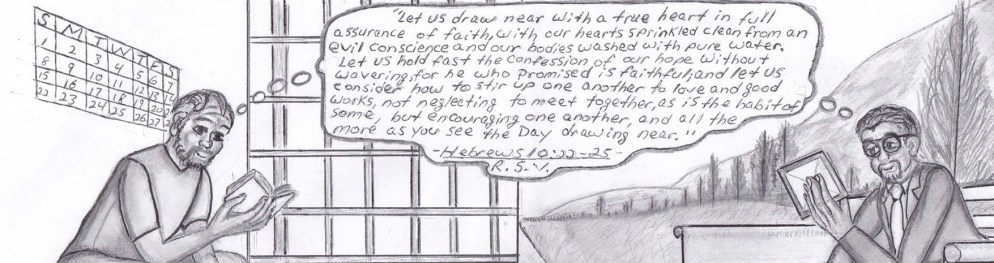
I love the Psalms. Every human emotion can be found there. If we are bold enough to read all of the psalms, and not just the pretty ones used in most churches, then we can be surprised. The full breadth of the Psalter shows more of our humanness than it does our holiness. And in my life I can be disappointingly human. I can be petty and angry, I can be depressed and lonely, I can even be lustful and covetous; I am only human. Often the prison atmosphere seems to intensify our worst and least attractive traits.
But Jesus didn’t come to give us a life suddenly free of all suffering, or free from all hardships. Jesus did come to endure them with us, to bring us comfort, to direct our gaze again towards the eternal God, and to bring hope. God’s incarnation into flesh shows us not a freedom from life, but a new and joyful existence in this very life. Jesus comes to us, to be with us, and to guide us into this new existence in God. That’s what Christmas is all about.
Come, O Father saving Son, who o’er sin the victory won. Boundless shall your kingdom be; grant that we it’s glories see. (Hymn 54)
 Prison Lectionary