8th Day of Christmas

by Matthew B. Harper

He said, “I am the LORD who heals you.”(Exodus 15:26)

Healing is a difficult subject for every Christian. We know that all of creation is God’s, and we know that it is fallen away from God. I do not believe the sickness of our lives is God’s intention, but I do believe that God allows it for a purpose – and we don’t always know what that purpose is. We pray for the healing that Christ brings, and we mourn and struggle when we do not see it come as we hope and expect.

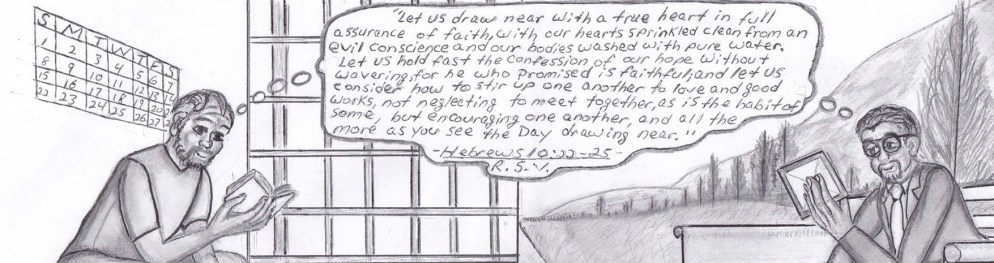
I lost a friend to cancer one Christmas. Even on his death bed the prison would not parole him so he could go and die at home. Instead he died in the prison infirmary, after having spent over half his life behind bars. We prayed for his healing, and he did not get better. We prayed for his release, and he was not released.

But during his struggles with his sickness he finally faced some deep questions and struggles he had with God. He began to address again the serious issues of forgiveness and reconciliation. He was here in prison, but he was very much loved and prayed for from the inside and outside community. A lapsed Catholic, he returned to the church and frequently celebrated the sacraments with the community.

Bubba died, and before he died he was healed.

Yea, Lord we greet thee, born this happy morning; Jesus to thee be glory given; Word of Father, now in flesh appearing; O come let us adore Him. O come let us adore Him, O come let us adore Him, Christ the Lord. (Hymn 83)

7th Day of Christmas

by Matthew B. Harper

Then Gideon built an altar there to the LORD, and called it, The LORD is peace. (Judges 6:24)

During this holiday season the word ‘peace’ is always before us. It decorates our Christmas cards, our homes, our clothes, and graces our lips. But even though we say it, do we really live it? Do we understand it? Can we?

Peace, by the worlds standard, is simply the lack of violence. That is a good and noble thing, but the peace of the Lord is much deeper and fuller than this. Jesus called it the peace that ‘passeth understanding,’ that is exactly what he meant. To say, even for a moment ‘oh, I get it,’ is to contradict Christ. No, we don’t ‘get it,’ we don’t understand it, but we can receive it, we can experience it, and by the grace of God we can live in it.

The peace that God gives is a deep restfulness, despite whatever else is going on, because the very depths of your soul is rooted and grounded in the love God has for you. It is a peace that cannot be bought, and cannot be sought; it is a peace that comes to us as a gift, and only as a gift. It can only be received. It is a peace that speaks quietly to us and calms us in the middle of the storm. It is a quiet calm that tells us to trust, not to fear, not to worry, and to rest in God’s hand. It is a peace that God gives to creation, and it is the present that Christ brought to us in his birth.

It is a peace that comes from knowing every moment is sacred unto God. It is a peace that comes from knowing that God pays little heed to prison fences, bars, or walls, but is always present with us. It is the peace that permeates every moment of our lives, and call us back to God.

It is this peace that I wish for you this day.

O come all ye faithful, joyful and triumphant, O come ye, O come ye to Bethlehem; come, and behold Him, born the King of Angels; O come let us adore Him, O come let us adore Him, O come let us adore Him, Christ, The Lord. (Hymn 83)

2nd Sunday of Christmas/Epiphany Sunday

by CM

Psalm 72:1-7, 10-14

Our Savior entered the world as a solution to a problem that a significant portion of the people in power didn’t even realize existed. Those who has the scriptures, those in positions in the government, those with the resources and the means to solve the problem never deployed them because they were blind to it.

Here comes Jesus, born King yet He carried a mandate from on high to bring a solution to a problem that was so prevalent that the powers that be sought to slay Him even as a baby. Why? Because His life was meant to expose those in authority, those in power, as the source of the problem.

Our reading identifies a number of issues: lack of justice and disenfranchisement of the poor, oppression, hopelessness, cruelty. These conditions are all results of sin. However, they lack the abstract notions of what constitutes one’s individual nature and squarely categorize the issues involved in the way the powerful treat the common man. It was the state that took issue with the life of Jesus, the religious folk who pledged loyalty to the state, “We have no king but Caesar.” Why? Because they couldn’t see THEMSELVES as the problem.

Being that those same problems still exist and persist, what are we not seeing today in relation to their presence? Jesus exposed the systematic injustice, unrighteousness, corruption, cruelty and evil in the simplicity of the fact that they killed him! Sometimes people have a tendency to gloss over that fact.

What does it say—right where the rubber meets the road—about ANYONE, ANY SYSTEM, that kills a person? Let that word sink in for a moment. A PERSON such as Jesus. Not, “Son of God,” not “The Christ.” We have to ask the question, was Mary’s baby boy a bad PERSON? Because make no mistake about it, in a very NON-ABSTRACT way, that is who they—the powerful, the ruling class, the government—killed. And unless he was at the very least a bad person, they killed him wrongfully.

Are we “divorced” from seeing the same today? Have we forgotten that Jesus said something about how the way we treat “the least of these” equals how we treat Jesus? If we take issue with seeing Jesus as simply being a Person, it may indicate a lack of the ability to see the downtrodden as Jesus.


6th Day of Christmas

by Matthew B. Harper

And Moses built an altar and called it, The LORD is my banner. (Exodus 17:15)

There are many battles that we fight as believers, and to hear God named as the ‘Battle Fighter’ is a powerful reassurance about what is truly going on. In this passage the Lord fights as Moses lifts his hands in praise, and when his arms grow weary it is his brothers who help hold them up.

The Christian community is a source of our strength and guidance, but it can often be the place of our battles as well. Some of the most hurtful and bitter battles that rage are the ones that tear us apart in our faith community. The Christian body can easily become divided over issues that work to pit us against each other, and tear at the fabric of our family of faith.

It is not wrong to fight and struggle for the truth of God to be known, recognized, and lived, but truth by itself becomes an empty law unto itself. A crusade of truth without love has given us little except a ‘Christian fundamentalist’ movement, just as the crusade of love without truth puts us on the edge of a dangerous liberalism. We cannot have one without the other. We cannot fight for anything if it is not the truth of God, but the only weapon that God has given us for the battle is love itself.

I am in prison, and my battles are many. They are battles of honesty, integrity, and faithful service. Battles of the spirit, heart, and mind. And for those on the outside the battles are the same. They are battles that are won by relying on our relationship with the Lord. They are battles where we can only stand in faith and let the Lord fight for us. And when the times are tough and we grow tired, there are times when we rely on the strength of our brothers and sisters to hold us up.

Of the Father’s love begotten, ere the worlds began to be, He is Alpha and Omega, He the source and ending He. (Hymn 82)

5th Day of Christmas

by Matthew B. Harper

So Abraham called that place ‘The LORD will provide’; as it is said to this day, ‘On the mount of the LORD it shall be provided.’ (Genesis 22:14)

This name of God is beloved of mine because it is not just a testimony, it is also a powerful reassurance. It is a reminder that God has provided for me in so very many ways, and that God will provide for me in anything that comes.

In my life I have always longed for family. I have always wanted to feel needed and necessary, valued and loved, as part of a loving community. But I have only a very small family, and it has long been fractured and broken. At this point in my life almost all of what little family I have left has abandoned me. But in that seeming loss, God has provided for me abundantly.

If I were to count all those people in my life now that I love and value, that I count as family, I would quickly run out of all of my fingers and toes, and most of yours as well! These people may not be considered part of my traditional family, but they are certainly part of my intentional family.

This intentional family does not come easily. It does not come without decisions and actions. We have to decide not just to be totally open to someone else, but we also have to love that person when they are totally open to us and we are subject to all of their secrets and foibles. Being a part of a loving family can be work, but it is wonderful work. It is work that allows us to overcome all of our separations and anxieties, and be accepted. A family allows us to be the most fully ourselves that we can be, and be accepted.

I do not know what the future of my life will bring, I have only plans, hopes, and dreams, but I know whom it is that I follow, and I know God will provide.

Joy to the world! The Lord is come: let earth receive her King; let every heart prepare Him room, and heaven and nature sing. (Hymn 100)

“Time-Released Details” (1st Sunday after Christmas)

1st Sunday after Christmas Day – December 27

1st Samuel 2:18-20, 26; Luke 2:41-52; Colossians 3:12-17

“Time-Released Details”

by CM

A parallel between the Old Testament reading and our Gospel reading is that we’re observing a moment of boyhood in the lives of two individuals who are intrinsically linked across the span of many generations: Samuel and Jesus. One eternally occupies the Throne of David as King of Kings and Lord of Lords, our Savior Jesus; while it was Samuel who became the man that inaugurated the line of Israel’s royalty and anointed its first two kings.

We also see the hearts of two mothers—Hannah and Mary—women who have prayed, dedicated their lives to faithfully carrying out the requirements of the law as a result of their devotion to God, and two women who have divine insight into the destiny of their special boys, even if they lacked the details. And it’s in the lack of details that the real value of the faith journey is revealed.

These mothers, looking at their boys, both of them products of God’s word to them in “time release” form. Who can say with certainty what the details of a boy’s manhood will look like? Yet, as is pointed out—in 1st Samuel 2:26, in relation to Samuel and Hannah; and in Luke 2:52, in relation to May and Jesus—both moms watched their boys grown in stature and in favor with God and men as they transitioned from boyhood to manhood.

So I ask you now, what has been produced in your life pursuant to your relationship with God which unites you in your experience of that production with Hannah and Mary? What has God brought into your life on a “time release” basis? Something that requires a period of maturation?

In what ways may you yourself be that time-released gift to humanity from on high? In what ways have you ever considered that the promise and purpose of your own life may be directly linked to the life of another across the span of generations?

It is this consideration that brings forth the sacred in your life. Embrace this truth and sanctify this reality by doing all things, be they in word or deed, in the name of the Lord Jesus, as is pointed out in our epistle reading, Colossians 3:17.

You can imagine, coming from the perspective of an incarcerated man, scriptures that highlight transitions across the passage of time—“time-release” workings of the hand of God—are particularly encouraging. May the areas in your life that require a period of maturation be seen in new light, and as our two mothers in these readings, keep these things in your heart and be encouraged too.

Before and After (Christmas Day)

Christmas Day

Hebrews 1:1-4 (5-12)

“Before and After”

by CM

Have you ever known a person who was stuck in the past? Everything they say is about, “The good old days.” People constantly caught up in nostalgia, pining for the comforts of yesterday, confusing “old-school” with “old-fashioned.” Just because an old pair of shoes is still comfortable doesn’t mean that they aren’t worn out and as with all things, change is inevitable.

Our text is written fro the benefit of those who have become comfortable with what was. People who are devoted to God in the context of a past deliverance. We have come to love the Lord and have a “testimony” to the truth of what God can do. We remember our former state, our particular sin, and in that deliverance we KNOW God; for it was through that experience that God spoke to use… in times past, our Before.

Our text illuminates the validity of a “before” experience. God spoke in time past through the prophets, but in these last days, he speaks through his son Jesus—the “After.” Many in the first century and up to this very day have a problem with the change that Jesus brought into the world. They were, and are, stuck in the before, but the real question is this. Does a person’s choice to be suck in the past equate to God remaining there too?

As we celebrate the birth of Jesus and acknowledge God’s transition in his means of communication from the old to the new, let’s open ourselves up to experience God work in our life in a new way. Let’s open ourselves up to a new “After” and be thankful for God’s “Before.”

The opening words of Psalm 98 read, “O sing to the LORD a new song.” In Jesus we have cause to. In all that we testify to, all of it is “before.” Move with an open willingness into the glorious “after” of what God wants to deliver you not just from, but to.

Christmas Eve

by Matthew B. Harper

He saw that there was no man, and wondered that there was no one to intervene; Then His own arm brought Him victory, and His righteousness upheld Him. (Isaiah 59:16)

Tonight is the calm in the storm. The presents are wrapped, the food is put aside, the traveling is over, and tomorrow is Christmas. Tonight is the night for celebration, for worship, and for community.

I love stuff. On the street I was a guy with lots of tools, lots of clothes, bookcases full, and a kitchen overflowing. I didn’t just love stuff, I loved my stuff. The world seemed to be teaching me that what I owned was the measure of my life, and I listened with both ears.

I’m in prison now, and most of my things have been long given away to friends and family, passed on to those people who can use them. But some of the things are being kept and stored by my family, and that is important to me. It is a type of promise to me, a promise that there will again come a Christmas when I can celebrate at home.

In prison I am not sustained by stuff, or by the memories of something I used to have. I am ministered to, sustained by, and loved by my family. The people that I love, if they are family of my birth or family of my choice, are the most precious things in my life.

Because the real measure of our lives is not the stuff, it is the people that are in it. The measure of our life is not what we have, it is how we love. I miss some of my stuff, (a favorite sweatshirt, a great CD, my bed) but I would not trade the full measure of everything that I own for one single of my friends.

After all, it is only stuff – and this is about love.

Once in royal David’s city stood a lowly cattle shed, where a mother laid her baby in a manger for His bed: Mary was that mother mild, Jesus Christ her little child – (Hymn 102)

Saturday, Third Week in Advent

by Matthew B. Harper

Cast your burden on the Lord, and He will sustain you; He will never permit the righteous to be moved. (Psalm 55:22)

The stories that sustain us are the ones that remind us of a constant and loving presence. If you ask a child what the best thing about Christmas is, their response will certainly include the gifts of material things. But when you ask an adult, they will talk of wonderful family gatherings, of times spent together, of love that is celebrated and honored.

This verse from the psalms comes in the midst of words of trouble and persecution, of prayers that are begging for revenge and deliverance. In the midst of this heartfelt cry of pain and confusion, the psalmist is resting on the calm and certain assurance of God’s constant loving presence.

The Israelites, God’s chosen people, lived with years of turmoil, uncertainty, and fear. They did not understand why God delayed in delivering them from the persecution they suffered. We can look back and say that they were not yet ready for God, but in truth they were still not yet ready when Christ did come; and we are still not ready today. Christ comes in His time, and our worthiness is not required.

No matter how confused and hectic life gets, especially during the holidays, we know Christmas is coming. We know that Christ has come amongst us, and we celebrate that day of his birth. No matter our physical or emotional trouble, no matter our persecution or captivity, we have the same calm assurance that the psalmist had. Cast your cares upon the Lord, and God will sustain and deliver us.

What is the crying at Jordan? Who hears, O God, the prophecy? Dark is the season, dark our hearts and shut to mystery.

(Hymn 69)

Monday, Third Week in Advent

by Matthew B. Harper

Blessed is he who considers the poor! The Lord delivers him in the day of trouble; (Psalm 41:1)

Throughout the Bible there is a clear preference given to those who are poor. In all human economic situations it is unfortunately true that some will have more, and some less. God gives us strong words to remember those who have less, and to get up and go do something about it.

I have a hard time with that. Prison teaches you to be selfish, (in case you didn’t already know how.) We have so very little in here, and we learn to guard our possessions and our emotions, to build a wall around our past histories and our future dreams. I fear when I think about myself as I grow older. What will I be like when I am free? Will I ever be able open up enough to find the true intimacy of a deep relationship? For years I lied about my crimes, and that betrayal prevented the deep intimacy that my fiancé and I longed for in each other. There is no room for deception in a loving relationship.

Christ comes into our lives to tear down our walls. When we invite God into our lives, we slowly become more open to inviting others in as well. We learn to yield to the impulse not just to be giving of our things, but also to be giving of our time, our energy, and our love. We learn to become vulnerable.

Christmas is a time when we often stop to reach out in ministry, or at least to write a check to a charity. But the Bible does not let us off the hook so lightly. Giving and serving is a lifelong part of a Christian life, to always be giving in our things, and more importantly, to be giving of ourselves. We are all spiritually and emotionally poor.

O heavenly word, eternal light, begotten of the Father’s might, who in these latter days wast born for blessing to a world forlorn; (Hymn 64)