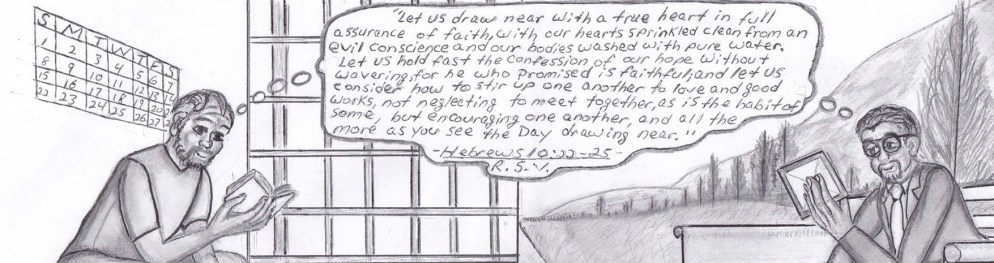
Advent Devotional Introduction (part 3)

On Sunday, November 29th and every day until Christmas, a daily reflection will appear to accompany and inspire readers in their own time of preparation.

Highways in the Desert

by Matthew B. Harper

Introduction

Part 3

click here to start with Part 1 (in case you missed it)

Prison is full of pain and strife, but that does not alienate God. Prison is full of despair, and that is where God is needed the most. In the world, God is often put aside by false idolatry. People get too busy, and push God aside. But there is no such thing as too much pain, longing, or despair for God. It is often in our pain that God is the most real and present to us. We live in the desert, and God lives here with us.

There have been so very many people in the history of our faith who have sought out the desert for a time. They have left family, friends, and security to travel into the wilderness so that they might seek God. Sometimes they have even formed communities in these places where they could seek and worship God together. I live in just such a place. I may not have made a deliberate and conscious decision to be here, and I could never have imagined the diversity of my fellow brothers, but we live and seek God together.

During our times in the desert it is not just the past memories or future dreams that sustain us. We do not simply think of how God has blessed somebody ‘back then,’ nor do we simply sit around and wait for a second coming. We are sustained in the desert by the very real and constant presence of our Lord and King. It isn’t just that Christ the King saved us; it is also that Christ is a constant presence in our lives and community. We are richly blessed.

Subscribe now to the Prison Lectionary blog, like us on Facebook, or follow us on Twitter. Don’t miss the five-part introduction to our devotional series, the devotions, or any other posts.

Advent Devotional Introduction (part 2)

On Sunday, November 29th and every day until Christmas, a daily reflection will appear to accompany and inspire readers in their own time of preparation.

Highways in the Desert

by Matthew B. Harper

Introduction

Part 2

click here to start with Part 1 (in case you missed it)

Prison is full of pain and strife, but that does not alienate God. Prison is full of despair, and that is where God is needed the most. In the world, God is often put aside by false idolatry. People get too busy, and push God aside. But there is no such thing as too much pain, longing, or despair for God. It is often in our pain that God is the most real and present to us. We live in the desert, and God lives here with us.

There have been so very many people in the history of our faith who have sought out the desert for a time. They have left family, friends, and security to travel into the wilderness so that they might seek God. Sometimes they have even formed communities in these places where they could seek and worship God together. I live in just such a place. I may not have made a deliberate and conscious decision to be here, and I could never have imagined the diversity of my fellow brothers, but we live and seek God together.

During our times in the desert it is not just the past memories or future dreams that sustain us. We do not simply think of how God has blessed somebody ‘back then,’ nor do we simply sit around and wait for a second coming. We are sustained in the desert by the very real and constant presence of our Lord and King. It isn’t just that Christ the King saved us; it is also that Christ is a constant presence in our lives and community. We are richly blessed.

Go to Part 3

Subscribe now to the Prison Lectionary blog, like us on Facebook, or follow us on Twitter. Don’t miss the five-part introduction to our devotional series, the devotions, or any other posts.

Advent Devotional Introduction (part 1)

On Sunday, November 29th and every day until Christmas, a daily reflection will appear to accompany and inspire readers in their own time of preparation.

Highways in the Desert

by Matthew B. Harper

Introduction

Part 1

“A voice cries: ‘In the wilderness prepare the way of the Lord, make straight in the desert a highway for our God.’” (Isaiah 40:3)

Writing about Advent from prison is a difficult thing. Advent is a time of Joy. It is a time of preparation. We are preparing in our hearts, and in our lives, for the coming Christmas celebration. Advent is a time of happy gatherings, frantic shopping, gift giving, a time of celebrations and rejoicing, a time of wonder and merriment. Advent is everything that prison is not. Maybe.

The above verse from the book of the prophet Isaiah is read at the beginning of the service for Morning Prayer. It is not read every day, just every day in Advent. John the Baptist would echo this cry of the prophet as he heralded the coming of Jesus the Christ. But the cry is not just a reminder to us of the coming of the birth of the Christ child, it is also a reminder that in the desert, in the barrenness, God is coming.

My godmother and spiritual director first introduced me to the term ‘desert.’ She used the term to describe those times in my journey when I found it hard to pray, hard to study, and hard to feel connected to God. When I would return to my daily cycles of prayer and study she would rejoice that I had ‘returned from the desert’. But in a very real way, all of prison is a barren desert. Prison is a place most marked not by what it is, but by what it is not. All those things Advent is. Prison isn’t.

It is not a new or unique idea to think of prison as a holy place, a place that is not unlike a church or monastery. But it isn’t. A church is a place that is full both of peace and praise; a location that is designed to lift your eyes, your attention, and your very soul towards God. Prison, in all those respects, is the anti-church. Prison is carefully and deliberately designed to direct you down, to crush your very soul into the ground and direct your gaze even lower. So when I came to prison I expected to find pain, guilt, and despair; I expected to see hate and violence; I expected to see people escaping into drugs, sex, and alcohol. I have seen and encountered all of these things in prison. What I did not expect to find was God, and every moment, of every day, in every place and time, God is here.

Go to Part 2

Subscribe to the Prison Lectionary blog, like us on Facebook, or follow us on Twitter. Don’t miss the five-part introduction to our devotional series, the devotions, or any other posts.

Matthew B. Harper

Matthew B. Harper is currently incarcerated in Virginia. Guilty of the murder of his sister Anne Elizabeth when he was 18, and the arson of their home, he pled guilty and has been in prison since 1999. With good time he anticipates release in the Summer of 2029. During his incarceration he has been sustained by loving ministry from his parents, friends, and the overwhelming grace of God. He is a published author and completed undergraduate and graduate degrees. He has worked as a chaplain’s assistant, led a religious community, tutored GED students, and currently trains therapy dogs. A cradle Episcopalian, he is currently a member of St. David’s Richmond and an Aspirant for Holy Orders.

Read contributions here.


“Going live” on Monday, November 23rd

Prison Lectionary will “go live” on Monday, November 23rd, 2015. This will be a week prior to the First Sunday of Advent, the beginning of the liturgical year in Christian tradition. On that day, we will release about a dozen new submissions at once and begin a regular cycle of publication.

Every Monday, Prison Lectionary will share commentary on the Revised Common Lectionary texts for the following Sunday and throughout the week other items will appear regularly.

During the Christian season of Advent, which begins four Sundays before Christmas, Prison Lectionary will share daily devotions prepared by a single incarcerated author.

Stay tuned for more great things to come!

Welcome to Prison Lectionary!

What is Prison Lectionary?

Prison Lectionary is a virtual space devoted to biblical interpretation by artists and authors incarcerated in jails or prisons in the United States. The purpose of this endeavor is two-fold. First, Prison Lectionary will provide a forum for the voices of prisoners, who are the most authoritative witnesses to the violence of the Prison Industrial Complex. Second, Prison Lectionary will serve as a repository of information for pastors and others as they study the Revised Common Lectionary texts or other Scriptures.

What is the Lectionary?

The Revised Common Lectionary is a three-year cycle of weekly readings used to varying degrees by the vast majority of mainline Protestant churches in Canada and the United States. It is built around the seasons of the Church Year, and includes four readings for each Sunday, as well as additional readings for major holidays. During most of the year, the readings are: a reading from the Hebrew Bible, a Psalm, a reading from the Epistles, and a Gospel reading. During the season of Easter, the Hebrew Bible reading is usually replaced with one from the Acts of the Apostles.

Who may submit writing or artwork to Prison Lectionary?

Prison Lectionary will accept submissions from anyone incarcerated in the United States.

What kind of writings and art are welcome?

Prison Lectionary invites any interpretive writing or art that engages with a biblical text. Texts from the Revised Common Lectionary are assigned to specific authors, but anyone is welcome to choose a biblical passage and submit a one-page commentary, a drawing, a prayer, or a poem based on the text. In the future, we also plan to publish book reviews, poetry, devotions, and articles on prison ministry and the criminal justice system.

What kinds of writings or art WILL NOT be published on Prison Lectionary?

Prison Lectionary seeks to foster a safe and respectful space for dialogue around the Bible and issues related to Mass Incarceration. Therefore, Prison Lectionary WILL NOT publish anything that advocates violence or disrespects anyone on the basis of race, religion, gender, economic class, sexual orientation, political ideology, or physical condition.

How do artists and writers contribute work?

Prisoners must use this release form to submit their work:  Prison Lectionary Release Form